| COMPANY | GreenCell Mobility (GCM), Mumbai · electric bus platform for intra-city and intercity routes (including the NueGo intercity brand) · MD and CEO Devendra Chawla · backed by Eversource Capital (CEO Dhanpal Jhaveri) |
|---|
| LATEST ROUND | ₹330 Cr equity from Impact Fund Denmark (IFDK) via the Danish SDG Investment Fund II, reported 13 Oct 2026 · covered by an EU guarantee under EFSD+ · IFDK's third e-mobility investment |
| EARLIER 2026 ROUND | US$89m mezzanine from IFC, British International Investment and Tata Capital |
| FLEET | 1,200 e-buses operating (Mercom) · plan for about 4,500 more, taking the fleet beyond 5,000 across 105 cities (Autocar Professional); another report says 4,500 in 100+ cities |
| ORDERS | 1,200+ buses under PM E-Bus Sewa (May 2025) · 570 buses for Delhi (Feb 2026) · 915 buses for Hyderabad with EKA Mobility under PM E-DRIVE (Mar 2026) |
| NOT PUBLISHED | Valuation, revenue, losses, IFDK stake |
| THE ACCESS POINT
GreenCell is private and owned mainly through Eversource Capital funds. Individuals can reach it only through those funds. No secondary market has been reported. |
|---|
Executive decision summary
| THE BOTTOM LINE | GreenCell Mobility raised ₹330 crore of equity from Impact Fund Denmark in October 2026 to deploy about 4,500 more electric buses, taking its fleet beyond 5,000 across 105 cities. It follows a US$89 million mezzanine round from IFC, British International Investment and Tata Capital earlier in 2026, so recent institutional money totals about US$124 million (about ₹1,200 crore). The business runs buses under long-term government and city contracts, including 1,200-plus buses under the PM E-Bus Sewa scheme, 570 in Delhi and 915 in Hyderabad with EKA Mobility. This is infrastructure-like income: contracted per-kilometre payments that depend on public agencies paying on time. What is not published is anything about profit, revenue or valuation. |
|---|
| WHICH INVESTOR | GreenCell fits a watch-list IF you want exposure to India's publicly funded e-bus build-out through a platform backed by development-finance institutions.
Wait IF you need revenue, profit or payment-delay data: none has been published. |
| COMFORT FIT | GreenCell = a bus fleet leased to the city. It owns and runs the buses; cities pay per kilometre under multi-year contracts.
Impact Fund Denmark, IFC and BII = development banks as shareholders. Patient, ESG-minded capital, not quick-exit capital.
The equity vs the debt = a down payment vs the loan. ₹330 crore equity across about 4,500 buses is a small slice; most funding is debt and mezzanine.
SolarSquare (Report 15) = another policy-driven climate business with development-finance backers. |
| THE RUPEIA NUMBER | 5,000+. The fleet GreenCell says it will reach across 105 cities after the Impact Fund Denmark investment, up from about 1,200 buses in operation (company and press reports). |
1 CLAIM REGISTER: EVIDENCE GRADING
| Claim | Source | Grade | Rupeia assessment |
|---|
| ₹330 Cr (DKK230m, ~US$35m) equity from Impact Fund Denmark | Autocar Professional (13 Oct 2026); Mercom India; Inc42 | C | Established |
| Fleet beyond 5,000 e-buses across 105 cities | Autocar Professional (company statement) | B | Company plan; Mercom: 4,500 buses in 100+ cities |
| US$89m mezzanine from IFC, BII, Tata Capital; fleet to 3,700 buses | Mercom India; Autocar (Feb 2026) | C | Established |
| 1,200+ buses under PM E-Bus Sewa (472 Madhya Pradesh, 750 Andhra Pradesh) | Autocar Professional (14 May 2025) | C | Established |
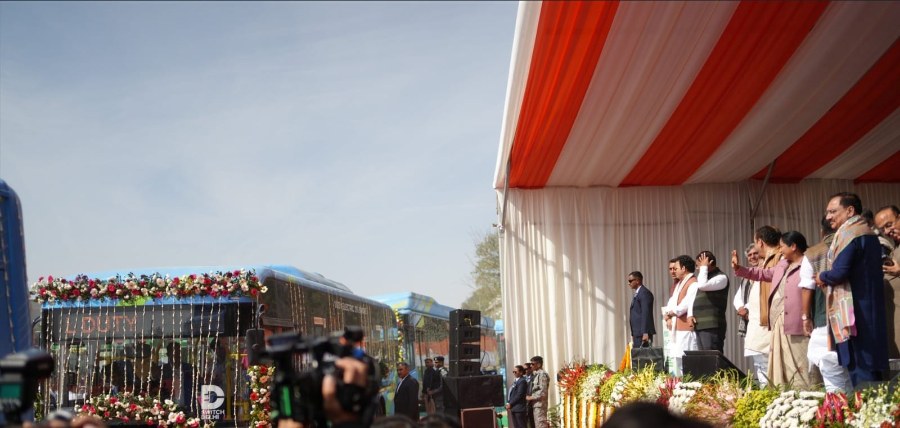
| 570 buses in Delhi; 500 flagged off at Ramlila Maidan | Autocar Professional (9 Feb 2026) | C | Established |
| 915 buses in Hyderabad with EKA Mobility under PM E-DRIVE | Outlook Business (23 Mar 2026) | C | Established |
2 THE FUNDING STACK
| Round | Amount | Investors | Purpose |
|---|
| Mezzanine, early 2026 | US$89m | IFC, British International Investment, Tata Capital | Fleet of 3,700 buses in Delhi, Madhya Pradesh, Andhra Pradesh, Bihar, Puducherry |
| Equity, Oct 2026 | ₹330 Cr (DKK230m, ~US$35m) | Impact Fund Denmark (Danish SDG Investment Fund II), EU-guaranteed | About 4,500 buses; fleet beyond 5,000 in 105 cities |
| Existing sponsor | Not disclosed | Eversource Capital | Platform investor |
| Calculation (Rupeia, ₹96.5 per US$) | Result |
|---|
| Recent institutional money | US$89m + US$35m = US$124m ≈ ₹1,200 Cr |
| Equity per planned bus | ₹330 Cr ÷ 4,500 = about ₹7.3 lakh |
| Fleet growth plan | ~1,200 buses to 5,000+ = about 4x |
| Fleet in May 2025 | 900 buses (UP, Gujarat, Maharashtra) |
| RUPEIA READ
The equity is a small slice of the cost of a bus fleet, so most of the build must be financed by debt and contract-backed lending, with the mezzanine layer in between. The investors are mostly development-finance bodies, which suggests the model is judged on climate impact and contracted cash flows rather than a quick exit. |
|---|
3 ORDERS: WHAT SUPPORTS THE FLEET
| Order or programme | Detail |
|---|
| PM E-Bus Sewa (May 2025) | Letter of award for 1,200+ buses from CESL: 472 Eicher buses in Madhya Pradesh with VECV, 750 buses in Andhra Pradesh via Pinnacle Mobility (EKA); six and eleven cities |
| Delhi (Feb 2026) | 570 buses; 500 flagged off at Ramlila Maidan; 12-metre air-conditioned buses |
| Hyderabad (Mar 2026) | 915 buses with EKA Mobility under PM E-DRIVE |
| Operating fleet | 900 buses (May 2025) to 1,200 (Oct 2026) |
| RUPEIA READ
Policy is the engine: central programmes (PM E-Bus Sewa and PM E-DRIVE) and city contracts have allotted thousands of buses, so demand is contracted. The risk is on the other side of the contract: payment security from state transport bodies. The sources read give no data on payment delays or margins. |
|---|
4 FLEET MATHS
| Measure (Rupeia calculation) | Value |
|---|
| Buses awarded in the three programmes read | 1,222 (472 + 750) + 570 + 915 = 2,707 |
| Awards as a share of a 5,000-bus fleet | ~54% |
| Buses to add to reach 5,000 from 1,200 | 3,800 |
| Per month over 36 months / 24 months | ~106 / ~158 |
| Institutional money since early 2026 | US$89m + US$35m = US$124m ≈ ₹1,200 Cr |
| RUPEIA READ
About half of the target fleet is already covered by awards, so the remaining half must come from new bids. Delivering 100–160 buses a month is a large step from the 300 added between May 2025 (900 buses) and October 2026 (1,200 buses), about 18 a month. |
|---|
5 WHO PAYS FOR THE BUSES
| Programme or customer | Buses | Counterparty |
|---|
| PM E-Bus Sewa, Madhya Pradesh | 472 (Eicher, with VECV) | Cities via CESL |
| PM E-Bus Sewa, Andhra Pradesh | 750 (with Pinnacle Mobility, EKA) | Cities via CESL |
| Delhi | 570 | Delhi Government |
| Hyderabad, PM E-DRIVE | 915 (with EKA Mobility) | Telangana authorities |
| RUPEIA CALCULATION
Four programmes, mostly state and city agencies, pay GreenCell. Revenue is predictable by contract but concentrated in government counterparties, so payment timing across those agencies is the biggest credit risk, and no payment data has been published. |
|---|
6 FUNDING STACK AND WHAT IT FINANCES
| Fact | Published detail |
|---|
| Mezzanine | US$89m led by British International Investment, IFC and Tata Capital, for zero-emission public transport |
| Fleet plan | Mercom gives two figures: 3,700 electric buses in one article and 1,200 buses with 170+ charging stations in another |
| Bank debt | ₹307 Cr (₹3.07bn) green financing from Sumitomo Mitsui Banking Corporation for 350 electric buses in Uttar Pradesh |
| Calculation (Rupeia) | Result |
|---|
| US$89m at ₹96.5 | ≈ ₹859 Cr |
| Mezzanine ÷ SMBC loan | ≈ 2.8x |
| SMBC loan per bus | ₹307 Cr ÷ 350 ≈ ₹0.88 Cr (₹88 lakh) financed per bus; the loan may not cover the full cost |
| Fleet gap between the two Mercom figures | 3,700 − 1,200 = 2,500 buses |
| RUPEIA READ
Bus operators are financed asset by asset, and the key numbers are how much of each bus is debt and how long the payment contract runs. The published stack shows lenders prepared to fund the model, but two fleet targets in the same publisher's coverage show how loosely the "plan" is stated. |
|---|
7 KEY TERMS USED IN THIS REPORT
The terms below are used throughout this report. The first table gives the general meaning; the second shows what each term refers to in this transaction.
| Term | Meaning |
|---|
| Primary vs secondary | Primary money goes into the company as new shares; secondary money goes to selling shareholders. |
| Post-money valuation | The company's value immediately after a round, equal to the pre-money value plus new money. |
| Run-rate | A recent period's revenue multiplied up to a year; it is not audited annual revenue. |
| ARR and GMV | Annual recurring revenue is contracted subscription income; gross merchandise value is the total value of goods sold on a platform. |
| Mezzanine finance | Capital that ranks between debt and equity, usually with a higher return than loans. |
| Dilution | The fall in existing holders' percentage when new shares are issued. |
| Term in this report | What it refers to here |
|---|
| Mezzanine | US$89m from IFC, BII and Tata Capital |
| Equity | ₹330 Cr from Impact Fund Denmark |
| Letter of award | Contract award for buses (PM E-Bus Sewa, PM E-DRIVE) |
| Fleet | 1,200 operating; 5,000+ planned |
8 RISKS, SCENARIOS AND FINAL VIEW
| Risk | Evidence | Severity | Kill condition |
|---|
| Counterparty payments | Revenue from public transport agencies | HIGH | Delays or disputes |
| Execution | Fleet to grow about 4x | HIGH | Deployment slips behind contracts |
| Leverage | Equity small vs fleet cost; mezzanine and debt | MEDIUM | Debt service strain |
| Disclosure | No revenue, margin or valuation | MEDIUM | Weak numbers when published |
| Policy dependence | Subsidy-linked programmes | MEDIUM | Programme changes |
| Scenario | What happens | Outcome |
|---|
| Bull | Fleet delivered on time; payments steady; profitable operations | Infrastructure-style returns; IPO or sale |
| Base | Fleet delayed but grows; margins thin | Moderate returns |
| Bear | Payment delays; funding strain | Restructuring pressure |
GreenCell has what an infrastructure operator needs: contracts, development-finance backers and a clear fleet plan. Rupeia's view: it looks like a financeable asset platform, and the missing disclosure is the evidence of cash conversion, which only audited accounts will show.
Frequently asked questions
How much did GreenCell Mobility raise?
₹330 crore (DKK230 million, about US$35 million) of equity from Impact Fund Denmark, reported on 13 October 2026.
What will GreenCell do with the money?
Deploy about 4,500 electric buses, taking its fleet beyond 5,000 across 105 cities, and execute its order book.
Who backs GreenCell?
Eversource Capital, Impact Fund Denmark, and in an earlier US$89 million mezzanine round IFC, British International Investment and Tata Capital.
How many buses does GreenCell run?
About 1,200 e-buses in operation, up from 900 in May 2025.
What orders does GreenCell have?
1,200+ buses under PM E-Bus Sewa, 570 in Delhi and 915 in Hyderabad with EKA Mobility under PM E-DRIVE.
Who runs GreenCell?
Devendra Chawla is managing director and CEO.
Is GreenCell profitable?
No financial results have been published in the sources read.
Source log
Autocar Professional: GreenCell Mobility raises ₹330 crore from Impact Fund Denmark for e-bus expansion (13 Oct 2026)
Mercom India: GreenCell Mobility raises US$35 million from Impact Fund Denmark
Inc42: GreenCell Mobility raises ₹330 Cr to expand electric bus fleet
Motor India: GreenCell Mobility raises ₹330 crore from Impact Fund Denmark
Autocar Professional: GreenCell Mobility deploys 570 electric buses in Delhi (9 Feb 2026)
Autocar Professional: GreenCell Mobility secures 1,200 electric bus order under PM E-Bus Sewa (14 May 2025)
Outlook Business: EKA Mobility, GreenCell Mobility to deploy 915 electric buses in Hyderabad (23 Mar 2026)
| DISCLAIMER
This document is published strictly for informational, educational and academic record-keeping purposes. The publisher is not a SEBI Registered Investment Adviser (RIA) or Research Analyst (RA). It does not constitute personal investment advice, a financial recommendation, or an offer or solicitation to buy, sell or subscribe to any securities. Investments in the securities market are subject to market risks. Read all related documents carefully before investing. |
|---|