Scapia: US$63 million Series C
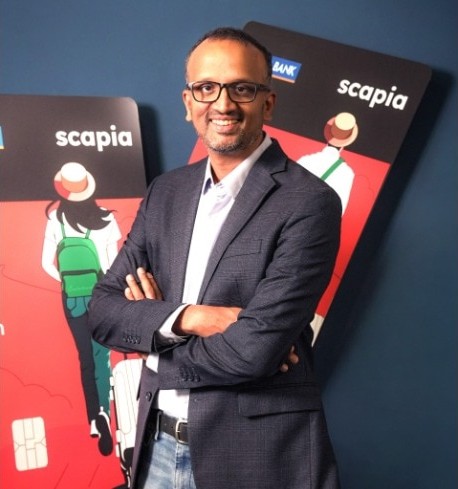
Anil Goteti, Founder and CEO, Scapia, in front of Scapia card artwork · Image: Scapia, via Business Today (May 2026)
Independent report content
| COMPANY | Scapia Technology Private Limited, Bengaluru · founded 2022 by Anil Goteti (Founder and CEO, formerly of Flipkart) · about 250 employees (TechCrunch, May 2026) |
|---|---|
| ROUND | Series C, US$63m (about ₹608 Cr at ₹96.5 per US$), announced 21 May 2026 · all-equity round per TechCrunch |
| INVESTORS | Led by General Catalyst · existing investors Peak XV Partners and Z47 participated · earlier backers include Elevation Capital, 3STATE, Tanglin |
| VALUATION | More than US$500m post-money (TechCrunch, unnamed source); about US$539m per Entrackr via Pulse.bot · Series B (April 2025): about US$193.5m (Entrackr) |
| FUNDING TO DATE | US$135m after the round (Business Today: US$72m before + US$63m) · TechCrunch gives US$126m |
| LATEST FINANCIALS | FY25: operating revenue ₹29 Cr, total income ₹40.4 Cr, expenses ₹123.5 Cr, net loss ₹83 Cr (RoC data via Entrackr and Inc42) · FY26: not published |
| BANK PARTNERS | Federal Bank (Visa and RuPay), BOBCARD, Axis Bank (Mastercard and RuPay, launched 3–4 September 2026) |
| THE ACCESS POINT Scapia is a private company. The Series C was bought by three institutional investors. Individuals can reach the company only through private secondary sales of its shares, or through funds that hold it. The latest price reference is the May 2026 round at more than US$500 million (about ₹4,800 crore). |
|---|
Executive decision summary
| THE BOTTOM LINE | Scapia is the fastest-moving of India's new travel-card fintechs, and also one of the most expensive to run. In four years it has raised about US$135 million across five rounds, grown customers sevenfold in the year to May 2026, and moved from one bank partner to three. But its last published accounts (FY25) show operating revenue of ₹29 crore against expenses of ₹123.5 crore, a net loss of ₹83 crore, and ₹4.26 spent for every ₹1 of operating revenue. The May 2026 round, led by General Catalyst at more than US$500 million, is a bet that rewards-led card spending will become a profitable travel-booking engine. No FY26 numbers have been published, so the bet cannot yet be checked against accounts. |
|---|---|
| WHICH INVESTOR | Scapia fits you IF you want exposure to India's card-led travel spending through a company that has just added a third bank, can fund itself for years from cash on hand, and you accept a valuation of about 166 times FY25 operating revenue. Wait IF you need FY26 audited accounts first. They have not been published, and the FY25 loss was nearly three times operating revenue. |
| COMFORT FIT | Scapia = the airline loyalty programme without the airline. Customers earn Scapia Coins on card spends and redeem them for flights, stays and visas, and Scapia pays for the rewards out of what it earns from banks and bookings. The bank partner = the landlord. Scapia owns the app and the customer, but the bank holds the licence and the lending. If the landlord changes the rules, as Federal Bank did in March 2024, the tenant has to adjust. Zero forex markup and lounge access = the loss-leader at the supermarket door. They bring travellers in; the earnings come from what they do next. Report 10 (DailyObjects) = a consumer brand that grew on about ₹100 crore of equity. Scapia has raised more than eight times that in US dollars and is still loss-making. |
| THE RUPEIA NUMBER | ₹4.26. Scapia spent ₹4.26 for every ₹1 of operating revenue in FY25 (₹123.5 crore of expenses on ₹29 crore of revenue), down from ₹6.59 in FY24. The ratio is falling fast. Whether it reaches ₹1 is the whole investment case. |
1 CLAIM REGISTER: EVIDENCE GRADING
A = government, regulator or statutory filing. B = company or manager release or website. C = independent press. D = third-party database, blog or aggregator.
| Claim | Source | Grade | Rupeia assessment |
|---|---|---|---|
| US$63m Series C led by General Catalyst; Peak XV and Z47 participate; announced 21 May 2026 | Z47 release; Business Today; Bar & Bench; TechCrunch | B | Established |
| Post-money valuation above US$500m | TechCrunch, citing a source familiar with the matter | C | Reported, not confirmed by the company |
| Post-money about US$539m; existing investors put in US$8m and US$5m | Entrackr, as summarised by Pulse.bot and search coverage | D | Reported |
| Total funding US$135m (US$72m before the round) | Business Today | C | Consistent with the sum of the four rounds |
| Total funding US$126m | TechCrunch | C | Conflicts with Business Today; difference not explained |
| FY25 operating revenue ₹29 Cr; net loss ₹83 Cr; expenses ₹123.5 Cr | RoC financial statements via Entrackr (18 Dec 2025); Inc42 | A | Established |
| FY25 total income ₹40.4 Cr including other income ₹11.6 Cr | Inc42 (article and Datalabs page) | D | Reported |
| Customers up 7x, flight bookings about 6x, hotel stays 8x in the year to May 2026 | Z47; TechCrunch; Business Today (5–6x for flights) | B | Company-reported, no absolute figures |
| Federal Bank stopped issuing new co-branded cards in March 2024 after RBI guidance | Federal Bank filing as reported by IIFL and Card Insider | C | Established |
| Axis Bank co-branded card launched 3–4 September 2026 | Deccan Chronicle; Livefromalounge | C | Established |
2 COMPANY OVERVIEW & FOUNDER
Scapia Technology Private Limited is a Bengaluru travel-fintech company founded in 2022 by Anil Goteti, who is described by Inc42 as a former senior vice president of Flipkart and by Z47 as someone who spent "eight years inside Flipkart". It sells a co-branded credit card, issued by partner banks, that earns Scapia Coins on spending and lets customers redeem them for flights, trains, buses, stays, experiences and visas inside the Scapia app. Around the card it has built UPI payments (Scapia Pay), credit-card bill payments through BBPS, a travel store and a booking engine.
Goteti had a previous start-up. Inc42 reported in June 2023 that Goteti had earlier co-founded Protonn with Mausam Bhatt, which "had to shut down its business" less than a year after raising a US$9 million seed round. Scapia is therefore a second-time-founder company, and its investors have backed Goteti through four rounds without changing the lead investor in the first three. No other co-founder is named in any source read for this report.
| Item | Published detail | Source |
|---|---|---|
| Legal entity | Scapia Technology Private Limited | Bar & Bench; Inc42 Datalabs |
| Founded | 2022, Bengaluru | Business Today; TechCrunch |
| Founder and CEO | Anil Goteti; former Flipkart senior vice president; earlier co-founder of Protonn | Inc42 (2023); Entrepreneur India (2025) |
| Headcount | About 60 (Nov 2023, target 100 by end-2024); about 250 (May 2026) | Inc42; TechCrunch |
| Advisers (Series C) | CMS INDUSLAW for Scapia; Khaitan & Co for General Catalyst | Bar & Bench |
3 TIMELINE: 2022–2026
| Date | Milestone |
|---|---|
| 2022 | Scapia founded in Bengaluru by Anil Goteti |
| Jun 2023 | US$9m seed round led by Matrix Partners India; Tanglin Venture Partners, Binny Bansal's 3STATE Ventures and angel Keki Mistry join. Federal Bank card has just launched |
| Nov 2023 | US$23m Series A co-led by Elevation Capital and 3STATE Ventures; card reached 7,500 pincodes within five months of launch; total raised US$32m |
| 12–13 Mar 2024 | After RBI guidance on 12 March, Federal Bank stops issuing new co-branded credit cards, including Federal Scapia |
| Jan 2025 | Domestic train bookings added |
| 3 Apr 2025 | US$40m Series B led by Peak XV Partners; total above US$70m; valuation about US$193.5m (Entrackr) |
| 2025 | Federal Bank resumes issuing co-branded cards with Scapia after about a year's pause, following RBI approval |
| 12 Jun 2025 | Dual-network Visa and RuPay card with UPI launched with Federal Bank |
| 5 Nov 2025 | Add-on credit card launched with Federal Bank |
| 18 Dec 2025 | FY25 accounts reported: revenue ₹29 Cr, net loss ₹83 Cr |
| 21 May 2026 | US$63m Series C led by General Catalyst; customers up 7x in a year |
| 3–4 Sep 2026 | Scapia Axis Bank Credit Card launched on Mastercard and RuPay, Scapia's third bank partner |
4 THE PRODUCT: A CARD, A WALLET AND A TRAVEL AGENT IN ONE APP
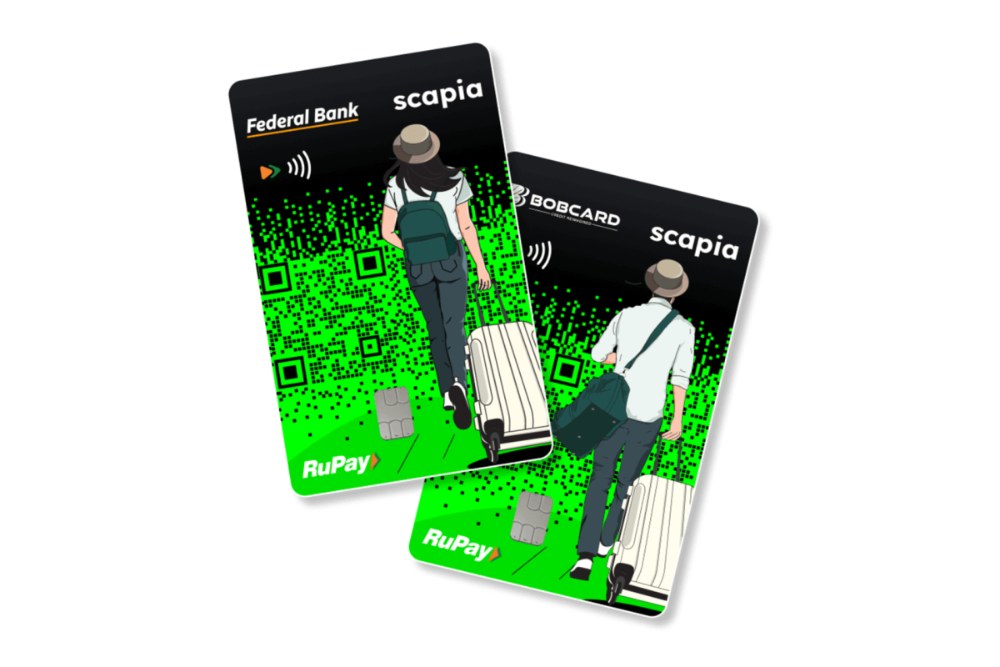
The company's own description, repeated by Z47 and Business Today at the time of the Series C, lists the following: a co-branded credit card on Visa and RuPay; Scapia Pay, a rewards-first UPI experience; add-on cards; credit-card bill payments across all banks through BBPS; Scapia Store and Scapia Experiences; Scapia Coins, earned on domestic spends and redeemable across flights, trains, buses, stays, experiences and visa services; and Airport Privileges, extended beyond lounges to dining, retail and duty-free. Spends abroad carry zero forex markup.
| Feature | What it does | Why it matters commercially |
|---|---|---|
| Co-branded card | Bank-issued credit card with Scapia branding; Visa, RuPay or both depending on the bank | Creates the customer relationship and the spend data |
| Scapia Coins | Rewards currency redeemed on the Scapia platform | Keeps rewards inside Scapia's own booking engine |
| Scapia Pay (UPI) | Everyday UPI payments that earn rewards | Raises transaction frequency beyond card swipes |
| BBPS bill payments | Pays credit-card bills of any bank | Brings in non-Scapia customers |
| Travel bookings | Flights, hotels (500,000+ properties per Entrepreneur India, 2025), trains, buses, visas for 45 countries | Booking fees and commissions are the revenue line that rewards spend should feed |
| Airport Privileges | Lounges plus dining, retail and duty-free credits | Answers crowding in lounges; Goteti told TechCrunch "Lounges are getting quite crowded." |
| RUPEIA READ Each feature addresses one weakness of a plain rewards card: swipes happen only a few times a month, so Scapia adds UPI; rewards fund other banks' travel sites, so Scapia adds its own booking engine; lounges get crowded, so it adds dining and shopping credits. About one in three users now choose shopping or food rewards over a lounge visit (Z47). The risk of breadth is cost: every added line needs its own compliance, support and fraud controls. |
|---|
5 THE BANK PARTNERS: FEDERAL BANK, BOBCARD AND AXIS BANK
Scapia does not lend. The card is issued by a regulated bank and Scapia supplies the brand, app, marketing and servicing. Three banks are now on the card. Federal Bank issued the original Visa card in 2023 and added a dual Visa and RuPay version with UPI on 12 June 2025, described by Business Today as having zero forex markup, unlimited domestic lounge access and a single statement for credit and UPI spends. BOBCARD (Bank of Baroda's card subsidiary) is the second issuer, with the customer choosing Visa or RuPay. Axis Bank is the third: the Scapia Axis Bank Credit Card was unveiled on 3–4 September 2026 on Mastercard and RuPay.
Launch of the Scapia Axis Bank Credit Card, September 2026: Anil Goteti (centre) with Axis Bank, Mastercard and NPCI executives · Image: Scapia and Axis Bank launch event, via Deccan Chronicle
| Bank | Network | Published terms | Date |
|---|---|---|---|
| Federal Bank | Visa; later Visa and RuPay | Zero forex markup; unlimited domestic lounge access on minimum spend; 10% rewards as Scapia Coins (2023 reports); fees not stated in sources read | Launched 2023; dual card 12 Jun 2025; add-on card 5 Nov 2025 |
| BOBCARD | Visa or RuPay, customer's choice | Terms not stated in sources read | Named as partner by May 2026 |
| Axis Bank | Mastercard and RuPay | Up to 10% rewards on eligible everyday spends; up to 20% in Scapia Coins on eligible travel bookings; zero forex markup; UPI spends earn rewards | Launched 3–4 Sep 2026 |
At the Axis launch Scapia called the card its third banking collaboration. Axis Bank was represented by Arnika Dixit (Group Head, Cards, Payments and Wealth Management), Mastercard by Gautam Aggarwal (President, India and South Asia) and NPCI by Sohini Rajola (Executive Director, Growth). Goteti said users had already taken Scapia to over 175 countries.
| RUPEIA READ Three issuers matter more than the card art. In March 2024 Scapia depended on one bank, and when that bank was told to stop issuing new co-branded cards, new-customer growth through that channel stopped. With three banks, and two networks plus RuPay-on-UPI, no single regulator action can shut the front door. It also lets Scapia bargain on reward funding. The cost is that each bank's credit policy, fee share and rewards funding must be managed separately. |
|---|
6 THE MARCH 2024 PAUSE: WHAT REGULATORY RISK LOOKED LIKE
On 13 March 2024, Federal Bank and South Indian Bank announced they had stopped issuing new co-branded credit cards, based on regulatory guidance received from the Reserve Bank of India on 12 March (IIFL and Card Insider reports of the exchange filing). Federal Bank said it would keep servicing existing co-branded cardholders and would continue non-co-branded cards, while it rectified deficiencies before resuming. Scapia's Federal Bank card was named in the filing. Coverage of the later resumption describes a "year-long pause" that ended after RBI approval, and Scapia began promoting the reissued card shortly afterwards.
| Aspect | Published fact | Source |
|---|---|---|
| Trigger | RBI guidance received 12 March 2024 | Card Insider; IIFL |
| Action | No new co-branded cards from Federal Bank; existing cardholders serviced | Federal Bank filing, reported by IIFL |
| Duration | About a year before resumption with Scapia | NewsMinimalist; Card Insider |
| Exact resumption date | Not stated in the sources read | - |
| Customer effect | Press reported reductions in some co-branded card limits (Medial summary); not quantified | Medial news summary |
| RUPEIA READ The pause is the single most important fact for a risk ledger. Scapia kept growing through 2024 and 2025 (the Series B was raised in April 2025, in the middle of the pause), which shows investors treated it as a regulatory event specific to one bank rather than to the model. It also explains the rush to add BOBCARD and Axis Bank. The lesson for a reader: partner count is a risk-control variable, not a vanity metric. |
|---|
7 BUSINESS MODEL: WHO PAYS FOR THE REWARDS
Scapia has not published its revenue model by line, but its RoC accounts and its public statements show the outline. FY25 operating revenue of ₹29 crore (Entrackr) was made up of service income ₹24 crore (82.8%), convenience fees ₹3.4 crore (more than tripled) and commission income ₹1.2 crore (up 71.4%). The sources do not say what sits inside "service income". The reasonable reading, consistent with how co-brand programmes work, is that it includes payments from partner banks and networks for card acquisition and spend, but the company has not said so.
Against that income, the cost base shows where rewards and servicing go. FY25 lines (Entrackr and Inc42): employee benefits ₹61 crore (up 72%), advertising ₹32 crore (down 35%), lounge services ₹7 crore (flat), subscription charges ₹7 crore, customer support ₹4 crore, other expenses ₹12.5 crore. Rewards that are redeemed against bookings may be netted off revenue or booked as cost; the accounts read for this report do not say which.
| Revenue pool | Who pays | What drives it | Published? |
|---|---|---|---|
| Card programme income | Partner bank, network | Card spend, active cards | Only as part of service income |
| Travel booking fees and commission | Airlines, hotels, customers | Booking volume and take rate | Convenience fees ₹3.4 Cr; commission ₹1.2 Cr (FY25) |
| Forex and other fees | Customers | Zero forex markup means none | Goteti has said Scapia gives up markup revenue |
| Store, experiences, visas | Customers and suppliers | Cross-sell | Not separately disclosed |
| RUPEIA READ In a rewards-led card the company pays customers up front (up to 10% on everyday spend and up to 20% in coins on travel for the Axis card) and recovers the cost later through bank payments and booking income. Goteti was reported after the Series B saying Scapia was willing to give up markup revenue because it saw the economics as one overall P&L. That makes the unpublished card-programme income the number that matters most, and it is not public. |
|---|
8 FINANCIAL FORENSICS: FY24 AND FY25
| ₹ crore | FY24 | FY25 | Change |
|---|---|---|---|
| Operating revenue | 17 (Inc42: 16.8) | 29 (Inc42: 28.7) | +70% (Entrackr) |
| Other income | Not stated | 11.6 | - |
| Total income | 24.1 (Inc42 Datalabs) | 40.4 | +67% (Datalabs) |
| Total expenses | 112 | 123.5 | +10% |
| Employee benefits | 35.5 | 61.3 | +72–73% |
| Advertising | 49.5 | 31.6–32 | -35 to -36% |
| Lounge services | 6.7 | 7.1 | +6% |
| Net loss | 87.9 | 83.1 | -6% |
| Expenses per ₹1 of operating revenue | ₹6.59 | ₹4.26 | -35% |
The two data sources disagree on "revenue" because they define it differently. Entrackr and the Inc42 article use operating revenue (₹29 crore, or ₹28.7 crore). Inc42 Datalabs uses total income including ₹11.6 crore of other income, which is ₹40.4 crore. Other income at that size is most likely interest on the large cash balance that followed the Series B, but the sources do not say so. For valuation arithmetic this report uses operating revenue and shows total income alongside.
Entrackr reports an EBITDA margin of −322.41% for FY25 without giving the absolute figure; Inc42 Datalabs estimates EBITDA at about −₹82.6 crore. Divided by operating revenue of ₹28.7 crore, the Datalabs estimate gives a margin of about −288%, so the two do not reconcile and the bases are unclear. Balance-sheet items reported: cash and bank balances of ₹305 crore, current assets ₹331 crore (Entrackr) and total assets ₹434.6 crore (Inc42 Datalabs). FY23 figures were not available in any source read.
| RUPEIA CALCULATION Employee cost was 49.6% of FY25 expenses (61.3 / 123.5) and advertising 25.6% (31.6 / 123.5). A year earlier advertising was 44.1% of expenses (49.4 / 112.1). Marketing spend fell by ₹18 crore while revenue rose ₹12 crore, so revenue growth in FY25 was not bought with a larger ad budget. The cost pressure shifted to people: payroll rose ₹25.8 crore. |
|---|
| RUPEIA READ The FY25 story is operating leverage in marketing and operating deleverage in payroll. The loss narrowed only 6% because the saving on advertising was almost entirely spent on staff. FY26 accounts will show whether the growth the company reports (customers 7x) arrived with a much larger payroll, and whether the revenue base has moved from tens of crores to hundreds. |
|---|
9 BREAK-EVEN ARITHMETIC: WHAT THE FY25 COST BASE NEEDS
Scapia has not published FY26 results. The figures below are Rupeia's own arithmetic on published FY25 numbers, designed to show the scale of the gap, not to forecast the company.
| Question | Calculation | Result |
|---|---|---|
| Revenue multiple needed to cover FY25 expenses (operating revenue basis) | 123.5 / 29 | 4.26x |
| Same on total income | 123.5 / 40.4 | 3.06x |
| Years to cover FY25 costs if revenue grows 70% a year and costs stay flat | ln(4.26) / ln(1.70) | About 2.7 years |
| Years of FY25 losses covered by cash at 31 March 2025 | 305 / 83 | About 3.7 years |
| Cash at 31 Mar 2025 plus Series C (US$63m at ₹96.5), before any FY26 burn | 305 + 608 | ₹913 Cr |
| Assumed annual cash burn | Years of runway on ₹913 Cr | Reading |
|---|---|---|
| ₹100 Cr | 9.1 | Roughly FY25 levels |
| ₹150 Cr | 6.1 | Burn rises with scale |
| ₹200 Cr | 4.6 | Heavy investment in AI hiring and brand |
| ₹300 Cr | 3.0 | Aggressive expansion into a fourth bank and new products |
| RUPEIA READ These are illustrations: FY26 burn is unknown, and the ₹913 crore figure ignores FY26 losses already incurred. They show that capital is not the short-term constraint. The constraint is margin. A business that must grow revenue more than fourfold at flat costs, or cut costs sharply, has to show the path before the next round, and a company that says a meaningful portion of the round goes to "building one of India's first true AI-native consumer organisations" (Z47) is signalling investment before economy. |
|---|
10 FUNDING HISTORY: EVERY ROUND
| Round | Date | Amount | Lead and participants (published) | Total raised after |
|---|---|---|---|---|
| Seed | Jun 2023 | US$9m | Matrix Partners India (lead); Tanglin Venture Partners; Binny Bansal's 3STATE Ventures; angel Keki Mistry | US$9m |
| Series A | Nov 2023 | US$23m | Elevation Capital and 3STATE Ventures (co-leads); Matrix Partners India and Tanglin (existing) | US$32m |
| Series B | 3 Apr 2025 | US$40m (about ₹342 Cr per IPO Central) | Peak XV Partners (lead); Elevation Capital, Z47, 3STATE Capital, Tanglin | Above US$70m |
| Series C | 21 May 2026 | US$63m (about ₹608 Cr) | General Catalyst (lead); Peak XV Partners and Z47 (existing) | US$135m (Business Today) |
| RUPEIA CALCULATION US$9m + US$23m + US$40m + US$63m = US$135m, matching Business Today's total. TechCrunch's US$126m is US$9m lower, which is the size of the seed round; the sources do not say why. The Series C is 46.7% of all money ever raised (63 / 135) and 1.6 times the Series B (63 / 40). |
|---|
Every round has been larger than the one before, each led by a different firm: Matrix, Elevation and 3STATE, Peak XV, then General Catalyst. Existing investors have stayed in at each stage. Entrackr reported that in the Series C, Peak XV and Z47 contributed about US$8 million and US$5 million, which would leave about US$50 million for General Catalyst. That is Rupeia's inference from Entrackr's figures (63 − 8 − 5 = 50), not a figure Scapia or General Catalyst has published.
11 INVESTOR FORENSICS: WHO IS ON THE CAP TABLE
| Investor | Entered | Published role | Quoted |
|---|---|---|---|
| Matrix Partners India / Z47 | Seed, Jun 2023 | Led the seed; Z47 participates in Series B and C. Vikram Vaidyanathan is quoted as MD of Matrix Partners India (2023) and of Z47 (2025–26) | Vikram Vaidyanathan: "few teams in Indian fintech have shipped this much, this fast" |
| Tanglin Venture Partners | Seed | Participated in seed, Series A and Series B | - |
| 3STATE Ventures / 3STATE Capital | Seed | Binny Bansal's firm; co-led Series A | Binny Bansal quoted at Series A |
| Keki Mistry | Seed | Angel investor, described as CEO of HDFC Ltd in 2023 coverage | - |
| Elevation Capital | Series A | Co-led Series A; participated in Series B | Mridul Arora, Partner |
| Peak XV Partners | Series B | Led Series B; participated in Series C | Tejeshwi Sharma, MD (2025); Sakshi Chopra (2026) |
| General Catalyst | Series C | Led Series C | Neeraj Arora, CEO India and MENA: round gives "real confidence in where this goes" |
The lawyers show who sat on which side. At the Series B, IndusLaw advised Scapia (Winnie Shekhar and Shantanu Singh); River Law advised Peak XV; Shardul Amarchand Mangaldas advised Elevation and Z47; Khaitan & Co advised 3STATE Capital; and Bombay Law Chambers advised Tanglin. At the Series C, CMS INDUSLAW advised Scapia and Khaitan & Co advised General Catalyst, with a team that included regulatory and competition-law partners. A lead investor bringing regulatory and competition counsel to a fintech round is consistent with the bank-partnership structure described above.
| RUPEIA READ Four of the five institutions that have written cheques are still investors, and the earliest backers (Matrix/Z47, Tanglin, 3STATE) have followed their money through four rounds. In India's consumer-fintech sector that is a stronger signal than headline valuation. What is not public is the share each now holds, the preference terms and the option pool, so no one outside the company can say who is ahead of whom in a sale. |
|---|
12 VALUATION ANALYSIS
| Round | Post-money valuation | Source | In ₹ crore (Rupeia) |
|---|---|---|---|
| Series B (Apr 2025) | About US$193.5m; TechCrunch: "around $200 million" | Entrackr; TechCrunch | ₹1,645 Cr (Entrackr) |
| Series C (May 2026) | More than US$500m | TechCrunch (unnamed source) | About ₹4,825 Cr at ₹96.5 per US$ |
| Series C, alternative | About US$539m | Entrackr via Pulse.bot | About ₹5,200 Cr |
| Multiple | Calculation | Result |
|---|---|---|
| Step-up, Series B to Series C (TechCrunch basis) | 500 / 193.5 | 2.6x |
| Step-up (Entrackr basis) | 539 / 193.5 | 2.8x |
| Series C price to FY25 operating revenue | 4,825 / 29 | About 166x |
| Series C price to FY25 total income | 4,825 / 40.4 | About 119x |
| Series B price to FY25 operating revenue | 1,645 / 29 | About 57x |
| Series C round as share of post-money | 63 / 500 | 12.6% (maximum, if all new money bought new shares) |
| General Catalyst implied stake | 50 / 539 | About 9.3% (Pulse.bot headline reports 9.2%) |
| RUPEIA READ The 166x multiple is not a fair measure of today's price, because the denominator is a year old and revenue has moved on since. It shows how much growth the round is already pricing. If revenue grows 70% a year, FY27 operating revenue would be about ₹84 crore (29 × 1.7 × 1.7) and the same valuation would still be roughly 57 times. Investors are paying for a path to bank-and-booking economics at scale, not for current earnings. A buyer of secondary shares should treat the May 2026 round as a ceiling for reference until FY26 accounts are public. |
|---|
13 GROWTH CLAIMS AND WHAT THEY DO NOT SHOW
At the Series C Z47 and Scapia said customers had grown about 7x across travel and card in the past year, flight bookings about 6x (Business Today wrote 5–6x), hotel stays 8x, and that the card was in use in 17,500+ pincodes and accepted in 150+ countries. Smaller cities were a growing share of bookings. No absolute customer, spend or booking figure was given.
| Date | Metric | Published figure | Source |
|---|---|---|---|
| Nov 2023 | Pincodes reached | 7,500 within five months of launch | Z47 Series A release |
| Nov 2023 | Customers from beyond top 30 cities | 40%; 75% salaried; average salaried income ₹2 lakh a month | Z47; Inc42 |
| Apr 2025 | Countries travelled to | Over 100 in the past year | Entrepreneur India |
| May 2026 | Customers, flights, hotels | 7x, about 6x, 8x year on year | Z47 |
| May 2026 | Pincodes | 17,500+ | Z47; Business Today |
| Sep 2026 | Countries travelled to | Over 175 | Anil Goteti, Deccan Chronicle |
| RUPEIA CALCULATION Pincode reach grew from 7,500 (November 2023) to 17,500 (May 2026): 2.3 times in about 30 months. Multipliers of 6x to 8x are year-on-year and start from a base the company has not stated. The FY25 accounts give one anchor: ₹29 crore of operating revenue. If FY26 revenue had also grown 6x it would be about ₹174 crore, but no FY26 revenue has been published, so this is arithmetic and not an estimate. |
|---|
14 MARKET CONTEXT: INDIA'S CARD AND TRAVEL BASE
RBI data reported by Angel One, Business Standard and others show a steadily growing card base. Outstanding credit cards were 115.78 million in December 2025, 116.65 million in January 2026, 118.63 million in March, 119.44 million in April, 122.85 million in July and 124.05 million in August 2026. Spending was ₹17.65 trillion in April–December FY26 (up 13.57%), about ₹23.62 trillion for FY26 as a whole (StartupTalky), ₹2.19 trillion in March 2026, ₹1.97 trillion in April, ₹2.08 trillion in July and ₹2.02 trillion in August (down 2.8% on the month, with online spending down 7%).
| Measure | Figure | Source |
|---|---|---|
| Cards outstanding, Jan 2026 | 116.65 million | Angel One (RBI data) |
| Cards outstanding, Aug 2026 | 124.05 million | Angel One (RBI data) |
| FY26 card spending | About ₹23.62 trillion | StartupTalky |
| Monthly spend, Aug 2026 | ₹2.02 trillion | Angel One (RBI data) |
| Spend per card per month, Aug 2026 | About ₹16,300 (Rupeia: 2.02 trillion / 124.05 million) | Rupeia calculation |
| Card growth, Jan to Aug 2026 | +6.3% (Rupeia: 124.05 / 116.65) | Rupeia calculation |
| RUPEIA READ The market is growing at a mid-single-digit pace in card count, so a company growing customers 7x is taking share from other issuers and co-brands, not riding the tide. The August 2026 dip in online spending is a reminder that travel-heavy cards depend on discretionary demand, airfares and visas. Z47 also said smaller cities were a growing share of bookings; the company has not published a domestic versus international split. |
|---|
15 COMPETITIVE LANDSCAPE
| Competitor type | Examples named in coverage | Their edge | Scapia's answer |
|---|---|---|---|
| Fintech travel and zero-forex cards | OneCard, Fi, Niyo, Jupiter | Similar zero-forex proposition; UPI-linked cards (Jupiter and Scapia both launched UPI-linked RuPay cards) | Three banks, a booking engine and Scapia Coins |
| Travel platforms | Ixigo and online agents | Inventory and booking scale | Card spend feeds the booking funnel |
| Bank-owned travel cards | Large banks' own premium cards | Balance sheet and brand trust | Lower fees, unlimited domestic lounges, rewards in a single app |
| Airline and hotel co-brands | Airline and hotel loyalty cards | Direct points redemption | Redemption across airlines, trains, buses and stays |
TechCrunch and Entrackr coverage groups Scapia with OneCard, Fi, Niyo and Jupiter, which "offer co-branded credit cards with zero-forex markup charges". Skift described the company in July 2026 as wanting "to own India's next wave of travelers through their credit cards". An aggregator profile lists the market as crowded and notes Scapia's heavy reliance on bank partners. No source read gives market-share numbers.
16 MOAT: WHAT IS HARD TO COPY
Customer relationship and data: the app sits between the bank and the traveller, so Scapia sees spend and booking behaviour that a bank-only card does not.
Multi-bank, multi-network structure: Federal (Visa and RuPay), BOBCARD (Visa or RuPay) and Axis (Mastercard and RuPay) make Scapia one of few co-brands present on all three networks. Business Today repeats the company's claim to be the first dual-network Visa and RuPay co-brand; this is a company claim.
Rewards currency: Scapia Coins can be redeemed across seven categories on its own platform, which keeps value inside the ecosystem.
Speed: Z47 says few Indian fintech teams "have shipped this much, this fast". Shipping speed is a moat only until a larger competitor copies the features.
What is not a moat: zero forex markup and lounge access are standard in the segment, and card issuance itself belongs to the bank.
17 REGULATORY MAP
| Area | Issue | Exposure for Scapia |
|---|---|---|
| RBI co-branding rules | RBI guidance of 12 March 2024 led Federal Bank to stop new co-branded cards; RBI later amended directions on co-brand marketing | Partner banks must be compliant; Scapia's growth channel depends on them |
| Credit-card issuance | Only banks and approved NBFCs issue cards; Scapia is a distribution and servicing partner | No balance-sheet credit risk, but reputational risk from limits, billing and recoveries |
| Payments (UPI, BBPS) | Scapia Pay and bill payments run through regulated rails | Compliance with NPCI and payment-system rules |
| Data and consent | Spend and booking data held across partners | Data-sharing terms with banks |
| Consumer protection | Refunds, cancellations and reward devaluation complaints | Customer trust in a rewards brand |
| RUPEIA READ The regulatory structure is the reason Scapia is capital-light on credit risk and also the reason its fate is partly outside its control. The 2024 pause shows the mechanism in action. Federal Bank's key fact statements and cardholder agreement were revised in January and April 2026 (Federal Bank documents), which indicates that terms are still being updated. |
|---|
18 RISK ANALYSIS: RED FLAG LEDGER & KILL CONDITIONS
| Red flag | Evidence | Severity | Kill condition | What would resolve it |
|---|---|---|---|---|
| Loss-making unit economics | FY25 loss ₹83 Cr on ₹29 Cr revenue; ₹4.26 spent per ₹1 | HIGH | FY26 loss widens faster than revenue | Audited FY26 accounts with improving ratio |
| Partner-bank dependence | Federal pause, Mar 2024; three banks now | MEDIUM | A second bank pauses or reprices rewards funding | Fourth bank; longer contracts |
| Rewards liability | Up to 10% everyday and 20% travel rewards (Axis card) | HIGH | Rewards cost grows faster than bank and booking income | Disclosure of net rewards cost |
| Payroll growth | Employee cost +72% in FY25; AI hiring planned | MEDIUM | Payroll above 60% of expenses without revenue lift | Revenue per employee reported |
| Valuation | About 166x FY25 operating revenue | HIGH | Next round flat or down | Revenue multiple compressing as FY26–27 revenue arrives |
| Competition | OneCard, Fi, Niyo, Jupiter, bank cards | MEDIUM | Share of new cardholders falls | Retention and spend per card disclosed |
| Information gap | No FY26 numbers, no cap table, no card counts | MEDIUM | Secondary buyers price on headlines | Audited filings |
19 SCENARIO ANALYSIS: FY27 AND BEYOND
| Scenario | What happens | Implication |
|---|---|---|
| Bull | Revenue grows more than 70% a year; Axis and BOBCARD cards scale; expense ratio falls below ₹2 per ₹1 by FY27 | Series D at a higher valuation; path to profit within the funded runway |
| Base | Revenue grows about 70%; ratio falls to roughly ₹2.5–3 per ₹1; losses stay large but fall as a share of revenue | Next round at a flat-to-modest step-up; slower pace of new products |
| Bear | A partner bank restricts issuance or cuts rewards funding; growth slows while payroll keeps rising | Down round or merger; rewards scaled back |
These are scenarios for discussion. They are not forecasts, and none is based on unpublished Scapia data.
20 INVESTOR CLASS ANALYSIS
For HNIs
Scapia shares are not listed. Access is through private secondary sales, and the only recent price reference is the May 2026 round at more than US$500 million. Buyers should not pay a premium to it before FY26 accounts are filed.
For family offices
A family office with a consumer-finance or travel theme could seek a co-investment in a later round. Preference terms and information rights matter more than headline price, and neither is public.
For institutions
Growth funds and global crossover investors are the natural next buyers. The presence of General Catalyst, a global growth investor, in the Series C suggests the next step is a larger round or a strategic sale, not a listing soon.
For NRIs
NRIs can buy unlisted Indian shares subject to FEMA pricing and reporting rules for non-resident purchases.
21 COMFORT FIT: THE DECISION PAGE
| If you want… | Best fit | Why | Caution |
|---|---|---|---|
| Exposure to card-led travel spending in India | SCAPIA | Seven-fold customer growth; three banks; US$63m fresh capital | Loss-making; no FY26 numbers |
| A consumer brand already near break-even | DAILYOBJECTS (Report 10) | Reported close to break-even on about 5x revenue | Different sector |
| A listed consumer-finance or travel exposure | Listed card issuers and travel platforms | Audited numbers and liquidity | Different growth profile |
22 THE EARLY SIGNAL: EVENTS TO WATCH
| When | Event | Why it matters |
|---|---|---|
| Late 2026 | FY26 financial statements filed with the Registrar of Companies | First view of revenue after the 7x customer growth |
| Q4 2026–2027 | Axis Bank card uptake | Tests whether a third bank broadens the funnel |
| 2027 | A fourth bank partner (TechCrunch said another was planned) | Further reduces single-issuer risk |
| 2027 | RBI actions on co-branded cards | Repeat of the March 2024 pattern would hit new-card growth |
| 2027 | AI-team hiring and payroll | Shows whether the AI-native plan is paid for by revenue |
23 RUPEIA FINAL INDEPENDENT VIEW
Scapia has done three hard things in four years: it persuaded three banks to put their licence behind a start-up's brand, it grew customers by about seven times in a year in a market where the card base grows by single digits, and it raised each successive round on the lead of a different top-tier investor. Its US$63 million Series C, led by General Catalyst at a reported valuation above US$500 million, gives it about ₹913 crore of cash and fresh capital on Rupeia's arithmetic (March 2025 cash plus the new money, before FY26 burn) to keep building.
What it has not yet shown, in any published accounts, is that a rewards-led card turns into profit. FY25 expenses were more than four times operating revenue. The ratio fell by a third in a year. Two things will decide the next valuation: whether FY26 accounts show operating revenue in the low hundreds of crores rather than tens, and whether the three-bank structure survives the next regulatory cycle.
| THE RUPEIA NUMBER ₹4.26: expenses per ₹1 of operating revenue in FY25, down from ₹6.59 in FY24. |
|---|
| RUPEIA VERDICT A well-funded, fast-growing but loss-making fintech priced for success. For secondary buyers, the May 2026 round is a ceiling reference until FY26 numbers arrive. For long-term investors, the key tests are the expense ratio in FY26 and FY27 and the behaviour of the three partner banks. |
|---|
Frequently asked questions
How much did Scapia raise in its Series C?
US$63 million (about ₹608 crore at ₹96.5 per US$), announced on 21 May 2026, led by General Catalyst with existing investors Peak XV Partners and Z47 participating. TechCrunch described it as an all-equity round.
What is Scapia's valuation?
TechCrunch reported a post-money valuation of more than US$500 million, citing a source. Entrackr, via Pulse.bot, reported about US$539 million. Scapia has not published a valuation. The Series B in April 2025 was valued at about US$193.5 million (Entrackr).
What is Scapia's revenue?
For FY25, operating revenue of ₹29 crore (Entrackr, from RoC filings) and total income of ₹40.4 crore including other income of ₹11.6 crore (Inc42). FY24 operating revenue was about ₹17 crore. FY26 numbers have not been published.
Is Scapia profitable?
No. The FY25 net loss was ₹83 crore (FY24: ₹87.9 crore), on expenses of ₹123.5 crore. Scapia spent ₹4.26 for every ₹1 of operating revenue in FY25, down from ₹6.59.
Who founded Scapia?
Anil Goteti, a former Flipkart senior vice president who earlier co-founded Protonn. Goteti is Founder and CEO.
Which banks issue the Scapia card?
Federal Bank (Visa and RuPay), BOBCARD (Visa or RuPay) and, since 3–4 September 2026, Axis Bank (Mastercard and RuPay). Scapia is the brand and technology partner; the banks issue and lend.
What happened to Scapia's Federal Bank card in 2024?
Federal Bank stopped issuing new co-branded credit cards, including Federal Scapia, on 13 March 2024 after RBI guidance on 12 March. It resumed issuing with Scapia after about a year, following RBI approval.
How much has Scapia raised in total?
About US$135 million: US$9m seed (June 2023), US$23m Series A (November 2023), US$40m Series B (April 2025) and US$63m Series C (May 2026). TechCrunch reported US$126 million.
Can individuals buy Scapia shares?
Scapia is unlisted. Shares can change hands only in private secondary transactions, and the company has not announced any listing plan. NRIs can buy subject to FEMA rules.
Source log
Scapia newsroom: Scapia raises US$63 million led by General Catalyst
Z47: Scapia Series C funding
Business Today: Scapia raises US$63 million led by General Catalyst
TechCrunch: Scapia more than doubles valuation to over $500m in a year
Bar & Bench: CMS INDUSLAW advises Scapia on US$63 million Series C
DealStreetAsia: Scapia raises US$63m led by General Catalyst
Fintech Global: Scapia raises $63m in General Catalyst-led round
Entrepreneur India: Scapia secures USD 63 Mn funding
YourStory: Scapia raises $63M led by General Catalyst
Pulse.bot: Decoding Scapia's Series C
Entrackr: Peak XV-backed Scapia reports ₹83 Cr loss on ₹29 Cr revenue in FY25
Inc42 Datalabs: Scapia financials
Inc42: Peak XV-backed Scapia spent over INR 4 to earn every rupee in FY25
YourStory: Scapia narrows losses 6% as revenue surges 70% to Rs 29 Cr
Inc42: Anil Goteti's Scapia raises US$9 Mn in seed funding
Z47: Matrix-backed Scapia raises Series A co-led by Elevation Capital and 3STATE Ventures
Inc42: Scapia bags US$23 Mn from Elevation Capital, 3STATE Ventures
Entrepreneur India: Scapia raises US$40M Series B led by Peak XV
Bar & Bench: Law firms advise on Scapia's US$40 million Series B
Inc42: Scapia nets US$40 Mn from Peak XV, others
IPO Central: Scapia raises INR 342 Cr in Series B
Card Insider: Federal Bank to present co-branded card proposal to RBI
IIFL: Banks take action on co-branded credit cards amid RBI guidelines
News Minimalist: Federal Bank resumes co-branded credit cards with Scapia
Deccan Chronicle: Scapia, Axis Bank launch co-branded card
Business Today: Scapia Federal credit card with RuPay, Visa and UPI
Skift: Scapia wants to own India's next wave of travelers
Angel One: Credit card spends decline in January; total cards 116.65 million
Angel One: Credit card spending declines 2.8% to ₹2.02 trillion in August 2026
StartupTalky: India credit card spending FY2026
| DISCLAIMER This document is published strictly for informational, educational and academic record-keeping purposes. The publisher is not a SEBI Registered Investment Adviser (RIA) or Research Analyst (RA). It does not constitute personal investment advice, a financial recommendation, or an offer or solicitation to buy, sell or subscribe to any securities. Investments in the securities market are subject to market risks. Read all related documents carefully before investing. |
|---|