FirstClub: US$55m (all primary) Series B
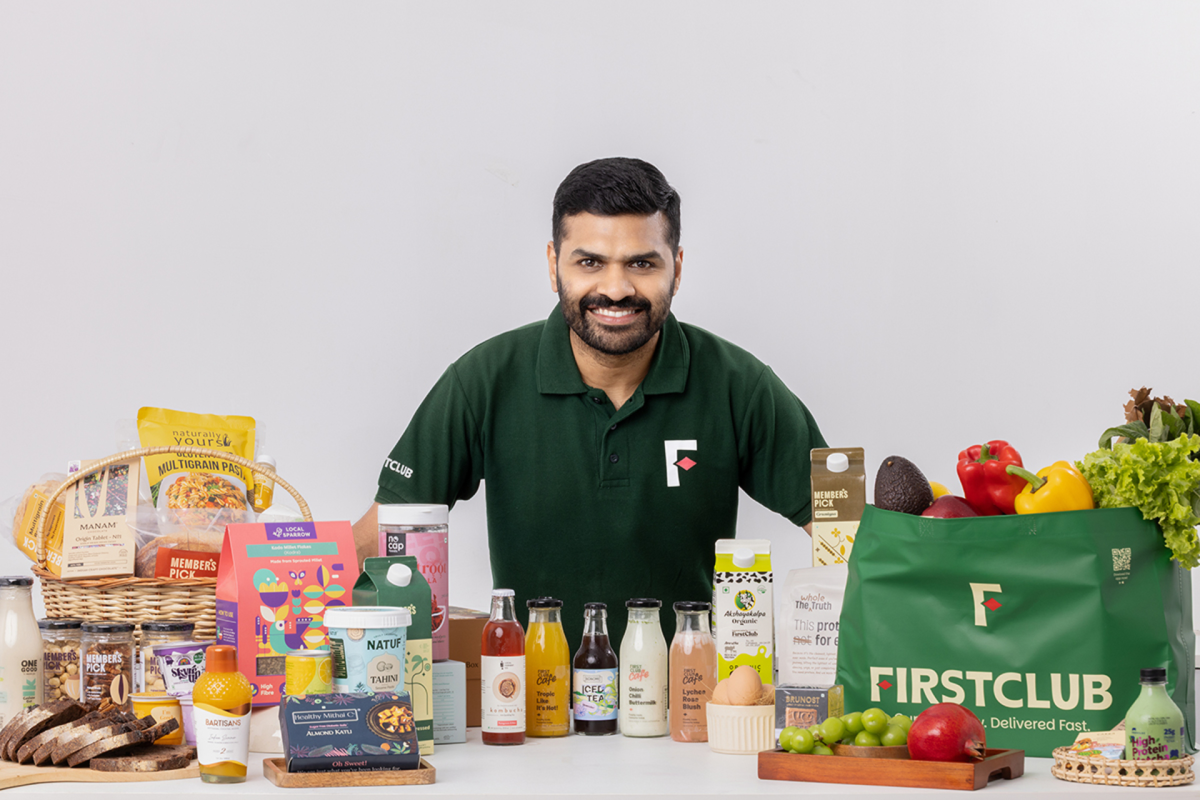
Ayyappan R, founder and CEO of FirstClub, with products from the FirstClub range · Image: FirstClub, via TechCrunch
Independent report content
| COMPANY | FirstClub (FirstClub Technology Private Limited), Bengaluru · founded December 2024 by Ayyappan R · app launched June 2025 |
|---|---|
| ROUND | Series B US$55m, announced 3–4 Jun 2026 · co-led by Peak XV Partners and Sofina · Accel, RTP Global and Paramark Ventures participated |
| VALUATION | US$255m post-money (some outlets: US$253m) · US$120m at Series A (Sep 2025) · US$40m at seed (Dec 2024) |
| FUNDING TO DATE | About US$86m: US$8m seed + US$23m Series A + US$55m Series B |
| TRACTION (COMPANY, JUN 2026) | 1m+ orders · 170,000 households · annualised GMV ~US$50m · ~₹1,200 per order · 4+ orders per month · 21 Bengaluru stores plus 3 in Hyderabad · ~220 employees |
| PROPOSITION | ~4,000 curated products, about a third of the range of many rivals · quality checks, lab tests on some staples, exclusive products · target: top 10% of households |
| USE OF FUNDS | More stores beyond Bengaluru, Hyderabad build-out, supply chain, quality systems, home and kitchen, gifting |
| THE ACCESS POINT FirstClub is a private company and no secondary market in its shares has been reported. Individuals can reach it only through funds that hold it. The Series B was all primary capital, so no existing shareholder sold in the round. |
|---|
Executive decision summary
| THE BOTTOM LINE | FirstClub is a Bengaluru grocery start-up that bets against speed. Instead of racing Blinkit, Zepto and Swiggy Instamart on 10-minute delivery, it sells about 4,000 curated products, tests quality, develops exclusive brands and targets the top 10% of Indian households. Its valuation rose from US$40 million in December 2024 to US$120 million in September 2025 and US$255 million in June 2026, a 6.4-fold increase in 18 months, on a US$55 million all-primary Series B led by Peak XV and Sofina. The company reports 1 million orders, 170,000 households and an annualised GMV of about US$50 million, with an average order of about ₹1,200. The price is about 5.1 times annualised GMV. What has not been published is anything about profit: revenue, contribution margin per store, cash burn and retention are not disclosed, and rivals with far larger scale are only now approaching break-even. |
|---|---|
| WHICH INVESTOR | FirstClub fits you IF you want exposure to premium Indian consumption and accept that the company is valued on growth and concept, with no published margin data. Wait IF you need published revenue, store-level economics or audited accounts. None has been released for FY25 or FY26. |
| COMFORT FIT | FirstClub = Whole Foods or Trader Joe's for Bengaluru. Fewer products, tested for quality, with exclusive brands, for customers who will pay more and wait a little longer. Blinkit, Zepto and Instamart = the supermarket that never closes. Vast range, minutes-fast, razor-thin margins and enormous scale. Curefoods (Report 05) = a food company the IPO market priced on profit. FirstClub will face the same test. DailyObjects (Report 10) = a premium Indian brand that used stores to cut paid marketing. FirstClub's 24 stores are both warehouses and brand showrooms. |
| THE RUPEIA NUMBER | 5.1x. US$255 million post-money value divided by about US$50 million of annualised GMV (Rupeia calculation). GMV is the total value of goods sold, not revenue, so the multiple on actual revenue is higher. |
1 CLAIM REGISTER: EVIDENCE GRADING
A = statutory filing. B = company statement or interview. C = independent press. D = third-party summary or aggregator.
| Claim | Source | Grade | Rupeia assessment |
|---|---|---|---|
| US$55m Series B co-led by Peak XV and Sofina; Accel, RTP Global, Paramark participating | TechCrunch (3 Jun 2026); Venture Intelligence; Bar & Bench | C | Established |
| US$255m post-money (up from US$120m in Sep 2025) | TechCrunch | C | Established; some outlets report US$253m |
| Total funding about US$86m | TechCrunch | C | Established |
| Series A US$23m at US$120m, co-led by Accel and RTP Global (Sep 2025) | TechCrunch (3 Sep 2025) | C | Established |
| Seed US$8m at US$40m (Dec 2024) | TechCrunch | C | Established |
| 1m+ orders, 170,000 households, ~US$50m annualised GMV, ~₹1,200 per order | Founder to TechCrunch | B | Company-reported |
| 21 Bengaluru stores; 3 Hyderabad locations; ~220 employees | TechCrunch | C | Company-reported |
| Quick-commerce market US$6.2bn (FY25) to US$11–12bn (FY26) | ICICI Securities via TechCrunch | D | Market estimate |
2 COMPANY OVERVIEW & FOUNDER
FirstClub was founded in December 2024 by Ayyappan R, who spent over a decade at Flipkart, where the founder led teams at its subsidiaries Myntra and Cleartrip, and earlier worked at ITC on expanding grocery and outlet coverage, according to TechCrunch. The company launched its app in June 2025 with four dark stores, which it calls "clubhouses", in a few Bengaluru localities.
The proposition is a deliberately narrow store. Founder Ayyappan said: "People don't need a very large selection, but they need the right quality selection, consistently delivered every single time." Peak XV's managing director GV Ravishankar compared the trend to premium grocery chains in developed markets and said that "there will be a specific set of consumers who gravitate toward a better-quality platform".
| Feature | FirstClub (published) |
|---|---|
| Customers | Top 10% of Indian households (about 20 million); 60–70% women or women-led households; target income about ₹15 lakh per household (Sep 2025) |
| Range | ~4,000 curated SKUs across packaged food, fresh produce, bakery, dairy and nutrition; roughly a third of many rivals' range |
| Exclusive products | 60% of products exclusive (Sep 2025); co-developed with brands |
| Quality control | Quality checks on fresh produce; lab testing of certain staples; blind consumer panel tests (for example, 20 paneer products tested and the top three listed); ban on products with over 200 ingredients judged harmful |
| Basket and cart rules | Average order ~₹1,050 (Sep 2025) rising to ~₹1,200 (Jun 2026); carts under ₹199 cannot check out |
| App design | Browse-led rather than search-led, to encourage exploration |
| RUPEIA READ The model is a selection play, not a delivery play. A narrow range cuts inventory risk and makes quality control feasible, but it also limits how much a household can buy in one order. The ₹199 minimum cart and the 4,000-item range screen for affluent, planned shoppers, which suits a premium positioning and works against the volume that quick-commerce rivals chase. |
|---|
3 TIMELINE: 2024–2026
| Date | Event |
|---|---|
| Dec 2024 | FirstClub founded; US$8m seed at US$40m valuation |
| Jun 2025 | App launched in Bengaluru with four dark stores ("clubhouses"); 4,000+ SKUs |
| 3 Sep 2025 | US$23m Series A at US$120m post-money, co-led by Accel and RTP Global; Blume Founders Fund, 2am VC, Paramark Ventures and Aditya Birla Ventures participate; plan for up to 35 Bengaluru clubhouses |
| Sep 2025 plans | Cafes within 30 days; home and general merchandise within six months |
| Before the announcement | Techstory reported the company was nearing a US$60m round at a valuation above US$250m |
| 3–4 Jun 2026 | US$55m Series B at US$255m post-money announced; 21 Bengaluru stores; Hyderabad launched with three locations; 1m orders and 170,000 households |
| Next | Expansion beyond Bengaluru and Hyderabad; home and kitchen, gifting and household essentials |
4 FUNDING HISTORY & INVESTOR FORENSICS
| Round | Date | Amount | Post-money | Investors named |
|---|---|---|---|---|
| Seed | Dec 2024 | US$8m | US$40m | Accel and RTP Global (returning investors in the Series A) |
| Series A | Sep 2025 | US$23m (over 90% equity, balance debt) | US$120m | Co-led by Accel, RTP Global; Blume Founders Fund, 2am VC, Paramark Ventures, Aditya Birla Ventures |
| Series B | Jun 2026 | US$55m, all primary | US$255m (US$253m in some reports) | Co-led by Peak XV Partners and Sofina; Accel, RTP Global, Paramark Ventures |
| Total | ~US$86m |
| Valuation step (Rupeia calculation) | Multiple | Time |
|---|---|---|
| Seed → Series A | 3.0x (US$40m → US$120m) | 8 months |
| Series A → Series B | 2.1x (US$120m → US$255m) | 9 months |
| Seed → Series B | 6.4x | 18 months |
| Series B cash ÷ total raised | 64% (US$55m of US$86m) | |
| Series B cash ÷ post-money | 21.6% (dilution if all new shares) |
| RUPEIA READ The investor line-up changes in useful ways. Accel and RTP Global, who led the earlier rounds, came back for the Series B, which is a positive signal from insiders who know the data. Peak XV and Sofina took the lead. A new lead paying 2.1 times the last round's price in nine months, and existing investors following, shows conviction, though the round was priced at a time of strong investor appetite for Indian consumer internet. |
|---|
5 THE BUSINESS MODEL: HOW FIRSTCLUB MAKES MONEY
FirstClub earns the gap between what it pays for products and what customers pay, minus the costs of running stores, delivery, quality control and technology. Four levers are visible in the published record: a higher average order (about ₹1,200, roughly twice that of leading quick-commerce platforms in groceries as reported in September 2025), exclusive products (60% of the range) that rivals do not stock, a narrower range that simplifies stocking, and frequent repeat orders (more than four a month on average among active customers).
| Lever | Published evidence | Margin effect (Rupeia view) |
|---|---|---|
| Larger basket | ₹1,050 (Sep 2025) to ₹1,200 (Jun 2026), about twice quick-commerce grocery baskets | Spreads delivery and picking cost over more rupees |
| Exclusive products | 60% of products exclusive in Sep 2025 | Higher gross margin potential; less price comparison |
| Repeat | 60% repeat purchase rate (Sep 2025); 4+ orders a month (Jun 2026) | Lowers acquisition cost per order |
| Narrow range | ~4,000 SKUs, a third of rivals' | Lower inventory and wastage; limits basket size |
| Speed | Not the focus; no delivery-time promise published | Lower rider and dark-store density costs than 10-minute models |
| RUPEIA READ The published levers all point to better margins per order than a mass quick-commerce player, but none is quantified in a margin. The company has not published revenue, gross margin, contribution margin per order or cash burn. Management's stated approach is steady expansion rather than a burn-heavy growth strategy (Whalesbook), which suggests it expects to manage losses, but no number backs that. |
|---|
6 THE NUMBERS: WHAT 170,000 HOUSEHOLDS AND US$50 MILLION OF GMV IMPLY
| Calculation (Rupeia, ₹96.5 per US$) | Result |
|---|---|
| Annualised GMV | ~US$50m ≈ ₹483 Cr |
| Orders per year at ₹1,200 per order | ~4.0m (about 335,000 a month; about 11,000 a day) |
| Orders per store per day (24 stores) | ~460 |
| GMV per store per year | ~₹20 Cr (~US$2.1m) |
| Active households if each places 4 orders a month | ~84,000, about half of the 170,000 acquired |
| Annual GMV per active household | ~₹57,600 (4 × ₹1,200 × 12) |
| Valuation ÷ annualised GMV | 5.1x |
| Valuation per acquired household | ~₹1.45 lakh (~US$1,500) |
| RUPEIA CALCULATION These figures are consistent with each other, which is a check on the published claims. An active household spending about ₹4,800 a month at FirstClub is a large share of a premium family's grocery budget, which fits a top-10% customer. At about 460 orders a day per store, each clubhouse handles a modest volume for a dark store; rivals handle more, which is why FirstClub's unit economics depend on ticket size rather than throughput. The valuation is about US$1,500 (about ₹1.45 lakh) per household acquired. |
|---|
7 ORDER ECONOMICS: A SENSITIVITY (ILLUSTRATIVE, NOT PUBLISHED)
FirstClub has published no margins. The table below shows how a ₹1,200 order could translate into contribution under stated assumptions. The gross margins and costs are Rupeia assumptions chosen to bracket typical grocery economics. They are not FirstClub data.
| Assumed gross margin on the basket | Gross profit on ₹1,200 | Contribution if cost to serve is ₹250 | If ₹300 | If ₹350 |
|---|---|---|---|---|
| 22% | ₹264 | ₹14 | –₹36 | –₹86 |
| 26% | ₹312 | ₹62 | ₹12 | –₹38 |
| 30% | ₹360 | ₹110 | ₹60 | ₹10 |
| 34% | ₹408 | ₹158 | ₹108 | ₹58 |
| Order volume (Rupeia calculation) | Annual orders | Annual contribution at ₹60 per order |
|---|---|---|
| Current: ~US$50m GMV | ~4.0m | ~₹2.4 Cr |
| If GMV doubles | ~8.1m | ~₹4.8 Cr |
| At 5x GMV (~US$250m) | ~20.1m | ~₹12 Cr |
| RUPEIA READ A ₹1,200 basket tolerates a surprisingly high cost to serve: at a 30% gross margin, a ₹300 cost per order still leaves ₹60. But contribution per order is small against the overheads of a 220-person company, so profit depends on volume rising several times from today's ~4 million annual orders. The illustration also shows the main risk: a drop in gross margin from 30% to 22%, for instance through price competition from Select or Gourmet, would push the same order into a loss. |
|---|
8 MARKET CONTEXT: INDIA'S QUICK COMMERCE IN NUMBERS
| Indicator | Figure | Source |
|---|---|---|
| Quick-commerce market | ~US$6.2bn (FY25) to US$11–12bn (FY26) | ICICI Securities via TechCrunch |
| India e-commerce GMV (2025) | ~US$60bn, growing ~18% a year to US$170–190bn by 2030 | Bain & Company via TechCrunch |
| Order share FY25 (Zepto DRHP) | Blinkit 44.4%, Zepto 30.9%, Swiggy Instamart 24.5% | Company filings via press |
| Orders FY26 | Blinkit 916.6m; Zepto 640.2m; Instamart 412.2m | Press reports of filings |
| Daily orders, Aug 2026 | Blinkit 3.4–3.6m; Zepto 2.4–2.6m; Instamart 1.3–1.45m | Datum Intelligence |
| Dark stores, May 2026 | 5,026 across the three leaders, up from 3,405 a year earlier | Press reports |
Different trackers rank the leaders differently by period, and one August 2026 report says Zepto now leads on daily orders. All agree on the scale: the three leaders each run more than 1,000 dark stores and process millions of orders daily. FirstClub's ~11,000 daily orders are a fraction of one percent of that.
| RUPEIA READ FirstClub is not competing for the mass market. It is carving out a high-income slice, about 10% of households by its own definition, in which basket size and trust count more than speed. The market data show why that slice is attractive: the leaders' growth has been fast, but their margins are thin, and affluent shoppers are the group most likely to pay for quality. |
|---|
9 COMPETITIVE LANDSCAPE
| Competitor | Edge | Weakness vs FirstClub (Rupeia view) |
|---|---|---|
| Blinkit (Eternal) | Scale, 10-minute delivery, near break-even adjusted EBITDA reported | Mass range; little quality curation |
| Zepto | Fast growth; large dark-store base; IPO-bound | Same mass positioning |
| Swiggy Instamart | Swiggy's customer base | Reported US$109m loss; share falling per filings |
| BB Now, Amazon Fresh, JioMart | Range, parent balance sheets | Less quality-led brand positioning |
| Specialty offline premium grocers | Trust and experience | No instant delivery |
Whalesbook noted that Blinkit and Zepto have scale advantages and deeper logistics networks that lower procurement costs, which could compress FirstClub's margins as its supply chain costs rise and quality-control risk grows in new cities.
| RUPEIA READ The leaders can copy parts of the FirstClub idea (premium lines, private labels), but a quality-first brand is hard to bolt onto a mass platform. FirstClub's defence is brand trust built on product testing, and its risk is that the leaders add curated premium shelves and win on convenience. |
|---|
10 THE LEADERS' ECONOMICS: WHAT FIRSTCLUB IS UP AGAINST
| Player (latest published) | Scale | Profit position |
|---|---|---|
| Blinkit (Eternal), Sep 2026 quarter | Net order value ₹20,940 Cr in the quarter, up 79.3%; 2,751 stores after 308 net additions; target 3,500+ by Mar 2027 and about 5,000 by Mar 2028 | Adjusted EBITDA ₹184 Cr (0.9% of NOV), against a ₹156 Cr loss a year earlier |
| Zepto, FY26 (IPO filing) | About 1,139 dark stores at Mar 2026 (1,029 a year earlier); order counts differ across press reports | Net loss about ₹5,905 Cr; adjusted EBITDA loss about ₹5,041.5 Cr; loss per order narrowed from about ₹136 to about ₹79 |
| Swiggy Instamart, FY26 (via IPO filing summaries) | Third in order share | Adjusted EBITDA loss about ₹3,511 Cr; Blinkit about ₹277 Cr in the same comparison |
| FirstClub, Jun 2026 | 24 stores, ~US$50m annualised GMV | Not published |
Eternal's September 2026 quarter showed Blinkit crossing into positive adjusted EBITDA at a margin of 0.9% of net order value, while group net profit of ₹125 crore missed analyst expectations of ₹271 crore. Blinkit said most new stores will open in smaller cities.
| RUPEIA CALCULATION Blinkit's quarterly net order value of about ₹20,940 crore compares with FirstClub's annualised GMV of about ₹483 crore. Blinkit does roughly 43 times FirstClub's annual volume every quarter, about 170 times on a like-for-like annual basis. Even the market leader earns under 1% of order value as adjusted EBITDA. A quality-first model therefore does not need to match leaders' scale. It needs a gross margin and basket size that leave positive contribution at a fraction of their volume, which is what a ₹1,200 order is designed to do. |
|---|
11 THE PREMIUM INCURSION: ZEPTO SELECT AND BLINKIT GOURMET
In July 2026 Business Today and other outlets reported that Zepto was preparing "Select", a premium grocery tab with imported and gourmet products for affluent urban buyers, initially in the top 40–60 cities, and described it as aimed at Blinkit Gourmet and FirstClub. Reports also said Blinkit, Swiggy Instamart and Flipkart Minutes were expanding beyond everyday essentials into premium groceries and specialty foods. Other online premium grocers named in coverage include Pluckk, Freshly and Handpickd, and Reliance's offline Freshpik; Nature's Basket is the established offline gourmet chain.
| Premium offer | Operator | How it differs from FirstClub (Rupeia view) |
|---|---|---|
| Select (reported, Jul 2026) | Zepto | A tab inside a mass app: shared riders, stores and customers, but not a stand-alone curated brand |
| Gourmet | Blinkit | Premium assortment inside the largest quick-commerce network |
| Premium sections | Swiggy Instamart, Flipkart Minutes | Same pattern |
| Pluckk, Freshly, Handpickd | Specialist online grocers | Closer peers, mostly fresh-produce focused |
| Freshpik; Nature's Basket | Offline retailers | Store-led, no instant delivery |
| RUPEIA READ The reported Select launch matters more than any financial detail: it shows that the mass players regard the premium segment as worth taking. FirstClub's response has to be trust and exclusivity. Its published tools are blind taste tests, a ban on over 200 ingredients (including artificial preservatives, colours and benzoates, according to a May 2026 interview), 60% exclusive products and, as described in the same interview, a planned Costco-style membership model. A "tab" inside a mass app finds it hard to match a platform where every product has been chosen for quality. |
|---|
12 PRODUCT EXPANSION: CAFES, HOME AND GIFTING
In September 2025 the founder said FirstClub would enter cafes within 30 days, serving freshly made rather than preheated food, and home and general merchandise (home decor, essentials, care, furnishing and utensils) within six months, along with children's food, pet food and nutraceuticals. By June 2026 the stated expansion list was home and kitchen products, gifting and household essentials.
| Category | Timing (published) | Reason (Rupeia view) |
|---|---|---|
| Cafes | Planned Oct 2025 | Brand-building and fresh food margin |
| Children's food, pet food, nutraceuticals | Planned | High-margin, quality-sensitive categories |
| Home and general merchandise | Planned within six months of Sep 2025; home and kitchen in Jun 2026 | Raises basket size and margin |
| Gifting and household essentials | Jun 2026 | Occasion-led demand; seasonal peaks |
| RUPEIA READ Adding home categories to groceries raises share of wallet, which is the right strategy for a narrow-range platform. It also stretches a 4,000-item range and the quality-control team. The test is whether each new category keeps the "tested and curated" promise. |
|---|
13 BRAND AND LOYALTY: "IF IT'S NOT GOOD, IT'S NOT HERE"
FirstClub's brand campaign is titled "If It's Not Good, It's Not Here", and in a May 2026 interview the founder said most quick-commerce players optimise for speed and assortment, while FirstClub chose quality and trust. The interview also described plans for a membership system inspired by the Costco model. In September 2025 the founder said the company wanted to offer slotted delivery, subscription delivery and eventually offline presence across multiple channels, and that it might invite customers into the clubhouses to show how hygiene and quality are maintained.
| Brand tool | Published detail | What it protects |
|---|---|---|
| Blind consumer panel | Products tested blind by a third-party panel; top three listed | Selection credibility |
| Ingredient bans | More than 200 ingredients barred | Health-conscious positioning |
| Exclusive range | 60% of products exclusive (Sep 2025) | Price comparison and margin |
| Membership (planned) | Costco-style, per May 2026 interview | Repeat orders and prepaid revenue |
| Open clubhouses (floated) | Customers invited to see hygiene standards (Sep 2025) | Trust |
| RUPEIA READ Membership is the most important unpublished piece. A paid membership would turn a high repeat rate into recurring, prepaid revenue, and give the company a cash buffer against the margin pressure that rivals can cause. No pricing or launch date has been published. |
|---|
14 GEOGRAPHIC EXPANSION: BENGALURU DEPTH, THEN HYDERABAD
| Date | Stores | Notes |
|---|---|---|
| Jun 2025 | 4 clubhouses | Launch in selected Bengaluru localities |
| Sep 2025 | 4, plan up to 35 | Plan to cover most of Bengaluru that year before entering a new city |
| Jun 2026 | 21 in Bengaluru, 3 in Hyderabad | Hyderabad recently launched |
At 24 stores in June 2026, FirstClub had opened about 20 stores in a year in Bengaluru and was about 14 short of its 35-store plan. The Series B proceeds are earmarked for expansion beyond Bengaluru and for deepening Hyderabad before further cities.
| RUPEIA READ The store count shows steady rather than explosive expansion. That fits a quality-led model, where each new store needs sourcing and quality systems, and it is consistent with the stated avoidance of burn-heavy growth. The risk is that quality control becomes harder city by city, a risk Whalesbook flagged. |
|---|
15 VALUATION ANALYSIS
| Metric (Rupeia calculation) | Value | Comment |
|---|---|---|
| Post-money ÷ annualised GMV | 5.1x | GMV is not revenue |
| Post-money ÷ gross profit | Not available | Margins not published |
| Post-money per store | ~US$10.6m (24 stores) | Includes brand and technology value |
| Seed-to-Series B step-up | 6.4x in 18 months | Very fast |
| Series B size ÷ GMV | 1.1x | Raised about a year of GMV in cash |
| RUPEIA READ At 5.1 times annualised GMV, FirstClub is priced well above where a grocery business is normally valued, because investors are paying for growth and a differentiated concept, not current profit. If GMV doubles to about US$100 million within a year, the multiple at today's valuation halves to about 2.6 times. The investment case rests on that growth and on the eventual margin of a premium-grocery model. |
|---|
16 MARKET CONTEXT: PREMIUM CONSUMPTION AND ONLINE RETAIL
| Indicator | Figure | Source |
|---|---|---|
| India online retail, 2026 | Projected to cross US$90bn, with grocery a key driver | Redseer, via press |
| Quick commerce, FY25 to FY26 | US$6.2bn to an estimated US$11–12bn | ICICI Securities via TechCrunch |
| Target households | Top 10%, about 20 million | FirstClub, Sep 2025 |
| Affluent segment caveat | Rising, but absolute numbers small relative to the mass market | Press analysis, 2026 |
| RUPEIA CALCULATION At about 20 million target households and 170,000 acquired in a year, FirstClub has reached about 0.85% of its stated addressable base. Even at ₹57,600 of annual spend per active household, winning 5% of the base (1 million households) would imply about ₹576 crore of annual GMV, only about 1.2 times today's level. Even a 10% share (2 million households) would be about ₹1,150 crore. Today's run-rate therefore already reflects a large share of what this narrow target base could spend, which means further growth must come from higher spend per household, new categories and a wider customer definition, not from the current segment alone. |
|---|
17 RISK ANALYSIS: RED FLAG LEDGER & KILL CONDITIONS
| Risk | Evidence | Severity | Kill condition |
|---|---|---|---|
| No published profit data | No revenue, margin or burn disclosed | HIGH | Contribution margin negative after scale |
| Scaled rivals | Blinkit, Zepto and Instamart process millions of orders a day | HIGH | Leaders launch tested-premium ranges at scale |
| Narrow customer pool | Target top 10% of households | MEDIUM | Growth stalls at 21–35 Bengaluru stores |
| Quality-control scaling | More categories and cities | MEDIUM | Public quality failure |
| Margin compression | Rising supply chain costs (Whalesbook) | MEDIUM | Gross margin falls as range broadens |
| Rapid valuation step-ups | 6.4x in 18 months | MEDIUM | Down round at Series C |
| Management bandwidth | ~220 staff, multiple new categories | LOW | Senior departures |
18 SCENARIO ANALYSIS
| Scenario | What happens | Outcome |
|---|---|---|
| Bull | GMV doubles; 60–80 stores across three cities; premium positioning holds; gross margin supports contribution break-even | Series C at a higher valuation; credible IPO path by 2029–2030 |
| Base | GMV grows 60–80%; stores reach 40–50; modest losses continue | Valuation grows slower than GMV; flat-to-modest step-up |
| Bear | Rivals add premium lines; growth in new cities slows | Down or flat round; acquisition by a larger player |
19 WHAT AN UNLISTED-SHARE BUYER SHOULD KNOW
No secondary transactions in FirstClub shares have been reported, and the Series B was entirely primary, so existing shareholders did not sell. Any future access would come through a later round, a secondary sale by early holders or an IPO. The company has not published its articles or investor rights. Rounds were mainly structured as equity, with the Series A including a debt component of under 10%.
| RUPEIA READ With a valuation that has multiplied 6.4 times in 18 months and no published profit data, any later secondary price will depend on how the next round is priced. A Series C at a flat valuation would be a normal outcome; a lower price would reset expectations for every holder. |
|---|
20 INVESTOR CLASS ANALYSIS
| Investor | Fit | Why |
|---|---|---|
| HNI | PARTIAL | Premium consumption theme; private shares are illiquid and valued on growth |
| Family office | PARTIAL | Fits via a growth fund; direct access not reported |
| Institution | PARTIAL | Consider after published profit data or a Series C |
| NRI | PARTIAL | Similar to HNI; FEMA and tax friction |
21 COMFORT FIT: THE DECISION PAGE
| CONSIDER EXPOSURE IF | You want premium Indian consumer growth and can accept a growth valuation without published margins. |
|---|---|
| WAIT IF | You need published revenue, contribution margin and burn, or want to see the Hyderabad and next-city results. |
| AVOID IF | You need a listed, liquid asset or a margin-based valuation. |
22 THE EARLY SIGNAL: EVENTS TO WATCH
| When | Event | Why it matters |
|---|---|---|
| Late 2026 | FY26 filings with the Registrar of Companies | First revenue and loss figures |
| 2026–27 | Hyderabad performance and a third city | Tests portability of the model |
| 2027 | GMV run-rate and store count versus the 35-store plan | Growth check |
| 2027 | Series C price | Valuation reset or confirmation |
23 RUPEIA FINAL INDEPENDENT VIEW
FirstClub has made a clear, distinctive bet and has executed quickly: a founder with long consumer-internet experience, four stores to 24 in a year, 170,000 households, and a valuation that has risen 6.4 times in 18 months with repeat backing from Accel and RTP Global and fresh leadership from Peak XV and Sofina. The published numbers are internally consistent and describe an affluent, high-ticket customer.
What remains unpublished is everything that determines whether the model earns money: revenue, margins, store-level economics and burn. Rupeia's view is that FirstClub is a high-quality growth story priced on concept, and that its value will be settled by whether a quality-first model can run with positive contribution margins as it leaves Bengaluru.
Frequently asked questions
What is FirstClub?
FirstClub is a Bengaluru-based curated grocery platform founded in December 2024 by Ayyappan R. It sells about 4,000 quality-checked products and positions itself as a trusted alternative to fast-delivery quick-commerce apps.
How much did FirstClub raise in its Series B?
US$55 million in June 2026, co-led by Peak XV Partners and Sofina, with Accel, RTP Global and Paramark Ventures participating, at a post-money valuation of about US$255 million.
What is FirstClub's valuation history?
US$40 million at seed (December 2024), US$120 million at Series A (September 2025) and US$255 million at Series B (June 2026).
How much has FirstClub raised in total?
About US$86 million: US$8 million seed, US$23 million Series A and US$55 million Series B.
What are FirstClub's traction numbers?
The company reports more than 1 million orders, 170,000 households, an annualised GMV of about US$50 million, an average order of about ₹1,200 and more than four orders a month among active customers.
Where does FirstClub operate?
Bengaluru, with 21 stores, and Hyderabad, where it launched with three locations in 2026.
Who are FirstClub's competitors?
Blinkit, Zepto, Swiggy Instamart, BB Now, Amazon Fresh and JioMart. FirstClub differs by curating about a third of their range and prioritising quality over speed.
Is FirstClub profitable?
No revenue, margin or loss figures have been published. Management describes a steady expansion rather than a burn-heavy strategy.
Can I buy FirstClub shares?
No secondary market has been reported. The Series B was all primary capital, so existing shareholders did not sell.
How profitable are Blinkit, Zepto and Instamart?
Blinkit reported a positive adjusted EBITDA of ₹184 crore (0.9% of net order value) in the September 2026 quarter. Zepto's FY26 net loss was about ₹5,905 crore, per its IPO filing as reported by press, and Instamart's adjusted EBITDA loss was about ₹3,511 crore in FY26.
Is anyone copying FirstClub's premium approach?
Reports in July 2026 said Zepto was preparing a premium "Select" grocery tab aimed at Blinkit Gourmet and FirstClub, and that Blinkit, Instamart and Flipkart Minutes were adding premium ranges.
Source log
TechCrunch: Quick-commerce FirstClub doubles valuation to US$255M in 9 months (3 Jun 2026)
TechCrunch: FirstClub bucks India's speed obsession, triples valuation to US$120M (3 Sep 2025)
Newskart: FirstClub raises US$55 million Series B
Whalesbook: FirstClub valuation doubles: can niche quality defeat scale?
Whalesbook: FirstClub valuation doubles to US$255M on quality-first bet
Venture Intelligence: Quick-commerce firm FirstClub raises US$55m led by Peak XV, Sofina
Bar & Bench: CMS INDUSLAW, Khaitan & Co act on FirstClub US$55 million Series B
Techstory: FirstClub nears US$60 mn fundraise as valuation crosses US$250 mn
NewsBytes: Quick-commerce start-up FirstClub doubles valuation to US$255M
Angel One: Zepto IPO, comparing Zepto with Blinkit and Swiggy Instamart
Entrepreneur India: Blinkit leads India's quick-commerce space as average daily orders shoot up
Apparel Resources: Instamart's share among q-commerce players declines
StartupTalky: Daily Indian startup funding roundup, 4 June 2026
Outlook Business: Eternal Q2 profit jumps 92% to ₹125 crore as revenue climbs 78%
Kotak Neo: Eternal Q2 FY27 results, Blinkit adds 308 stores
YourStory: Eternal Q2 net profit rises 92% in FY27
Outlook Business: Zepto doubles revenue in FY26 but losses reach ₹5,905 Cr
Outlook Business: How far Zepto fell short of its breakeven goals
INDmoney: Zepto DRHP analysis, how it compares with Blinkit and Instamart
Business Today: Zepto to take on Blinkit Gourmet, FirstClub with premium grocery service Select
Whalesbook: India's premium grocers bet on quality, not speed
YourStory: Why online grocers are keen to serve picky customers with premium produce (Jan 2026)
100x Entrepreneur podcast: The grocery market is obsessed with speed, FirstClub is betting on quality
| DISCLAIMER This document is published strictly for informational, educational and academic record-keeping purposes. The publisher is not a SEBI Registered Investment Adviser (RIA) or Research Analyst (RA). It does not constitute personal investment advice, a financial recommendation, or an offer or solicitation to buy, sell or subscribe to any securities. Investments in the securities market are subject to market risks. Read all related documents carefully before investing. |
|---|