Skyroot Aerospace: US$1.1bn valuation
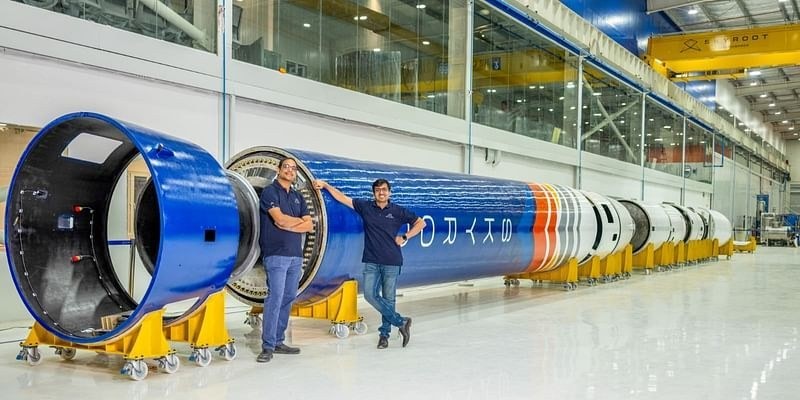
A Vikram launch-vehicle stage in Skyroot Aerospace's factory · Image: YourStory
Independent report content
| LATEST ROUND | ~US$60m equity, 7 May 2026 · led by Sherpalo Ventures and GIC · plus ₹100 Cr (~US$10.75m) NCD from BlackRock (Mar 2026) |
|---|---|
| VALUATION | US$1.1bn (India's first spacetech unicorn) · up from ~US$519m (2023) and ~US$165m (2022, Entrackr estimate) |
| CO-INVESTORS | BlackRock-managed funds · Greenko Group founders · Arkam Ventures · Playbook Partners · Shanghvi Family Office |
| TOTAL RAISED | More than US$160m (~₹1,500 Cr) in equity, plus debt |
| LAUNCH RECORD | Vikram-S suborbital (18 Nov 2022) · Vikram-1 orbital, Mission Aagaman (18 Jul 2026): 450 km, 60° orbit, first attempt |
| FY26 (PROVISIONAL) | Operating revenue ₹100.6 Cr, all from Space Systems products · EBITDA –₹130.3 Cr · customer advances >₹252 Cr |
| COMPANY PLAN | FY27 revenue ₹977 Cr (₹345 Cr launch + ₹633 Cr Space Systems) · FY32 ₹13,205 Cr |
| CONTRACTS | Reflect Orbital: two dedicated launches incl. first Vikram-1U (Oct 2026) · Exolaunch · Axiom Space MoU · Concert Technologies (Brazil) MoU |
| COMPANY | Founded 12 Jun 2018, Hyderabad · Pawan Kumar Chandana (CEO & CTO), Naga Bharath Daka (COO), both ex-ISRO · 1,000+ employees |
| THE ACCESS POINT Skyroot Aerospace Private Limited is unlisted. Its shares change hands only in private secondary transactions, settled into the buyer's demat account through the company's registrar. The May 2026 round was institutional (Sherpalo, GIC, BlackRock funds, family offices). Prices for individual buyers in the unlisted market are set by supply and demand, not by the company. |
|---|
Executive decision summary
| THE BOTTOM LINE | Rupeia's June 2026 IC Note called Skyroot "a single binary bet": would Vikram-1 reach orbit? On 18 July 2026 it did, on the first attempt. It put payloads into a 450 km orbit and made Skyroot the first private company to launch an orbital rocket from India. The technology question is answered. The question now is commercial. Skyroot is valued at US$1.1 billion on ₹101 crore of FY26 revenue, all of it from selling rocket and satellite parts, none yet from launches. Its own plan calls for ₹977 crore in FY27, including ₹345 crore from launches. That needs roughly a launch a month in the first commercial year. The customer side is real: ₹252 crore of advances, ₹605 crore of parts orders, and a US customer (Reflect Orbital) that has ordered two dedicated launches. The factory side is now the test. |
|---|---|
| WHICH INVESTOR | Skyroot fits you IF you want exposure to India's most strategic private space asset, accept a valuation that prices in several years of growth, and can buy unlisted shares and hold them until an IPO or strategic exit. Wait IF you need proof of commercial cadence first. The second Vikram-1 flight (planned before end-2026) and the first Reflect Orbital launch (around Q1 2027) are the next two hard data points, and both are months away. |
| COMFORT FIT | Skyroot after Vikram-1 = a new airline after its first commercial flight. The aircraft flew and landed. Now it must run a timetable, fill seats and keep costs down, and that is what the valuation is betting on. Agnikul Cosmos = a second airline still in flight testing. Its suborbital demonstrator flew in May 2024, and its orbital flight is still to come. ISRO's SSLV = the national carrier's regional jet. Proven and government-backed, but scheduled around national missions. Rocket Lab Electron = the global low-cost leader. Skyroot's CFO benchmarks against it and claims to be priced at about half its cost. |
| THE RUPEIA NUMBER | ₹252 crore. That is the customer advances Skyroot held in March 2026, four months before its rocket had ever reached orbit. Customers paid in advance for a product that had not yet been proven in orbit. More than the US$1.1 billion valuation, this is the clearest evidence that Skyroot's demand is real and not just investor enthusiasm. |
1 WHAT CHANGED SINCE RUPEIA'S JUNE 2026 IC NOTE
| Item | June 2026 IC Note | November 2026 | Effect on the thesis |
|---|---|---|---|
| Orbital insertion | Not yet achieved; "every forward assumption is conditional" | Achieved 18 Jul 2026 on the first attempt; 450 km, 60° orbit | Binary technology risk removed |
| Launch customers | Exolaunch partnership; government pipeline claimed | Reflect Orbital orders two dedicated launches (14 Oct 2026) | First named post-launch commercial customer |
| Product line | Vikram-1 (350 kg) and Vikram-2 (2027) | Adds Vikram-1U with strap-on boosters (550 kg); first 1U flight sold to Reflect Orbital | Bigger payload class without waiting for Vikram-2 |
| International | Exolaunch (Germany), Axiom Space MoU (US) | Adds Concert Technologies MoU (Brazil, 7 Oct 2026) to develop a 100 kg-class launcher | International technology partnership |
| Next flight | Not scheduled | Second Vikram-1 flight planned before end-2026 | Cadence test begins |
| FY26 accounts | Provisional ₹101 Cr revenue (Entrackr) | Unchanged; FY27 plan ₹977 Cr | Execution now the test |
| RUPEIA READ The June note's central risk, orbital failure leading to an 18–24 month recovery and a down-round, did not happen. The risk has moved from "can it fly?" to "can it fly often?". Valuation risk is unchanged: the price was set in May, before the launch, so the successful flight validated the valuation rather than raising it. |
|---|
2 CLAIM REGISTER: EVIDENCE GRADING
A = government, regulator or third-party record. B = company filings or provisional financial statements. C = independent press. D = company statement.
| Claim | Source | Grade | Rupeia assessment |
|---|---|---|---|
| Vikram-1 reached orbit, 18 Jul 2026 | Launch records; CNBC; Space.com; Al Jazeera (AFP/Reuters); Via Satellite | A | Established |
| First private orbital launch from India; India third country with private orbital launch (after US and China) | Wikipedia; Al Jazeera | C | Established |
| US$1.1bn valuation after ~US$60m round | TechCrunch; Bloomberg; Trilegal | C | Established as the disclosed round price |
| FY26 operating revenue ₹100.6 Cr; EBITDA –₹130.3 Cr | Provisional statements reviewed by Entrackr | B | Established, provisional |
| FY25 operating revenue nil; FY23–24 "revenue" was interest income | MCA filings via Entrackr; Rupeia June IC Note | B | Established |
| Customer advances >₹252 Cr (Mar 2026); >₹605 Cr Space Systems orders by FY28 | Entrackr (company documents) | B | Established, company-reported |
| FY27 ₹977 Cr and FY32 ₹13,205 Cr revenue | Company projections via Entrackr | D | Management plan |
| Reflect Orbital: two dedicated launches | Reflect Orbital announcement (14 Oct 2026); Via Satellite | C | Established; terms not published |
| Vikram-1 costs ~US$3.5m per launch; ~half of Electron | Skyroot CFO interview | D | Company claim |
| Infinity Campus can build one orbital rocket a month | Wikipedia / company | D | Stated capacity |
3 COMPANY OVERVIEW
Skyroot Aerospace Private Limited was founded on 12 June 2018 in Hyderabad by Pawan Kumar Chandana and Naga Bharath Daka, both former ISRO scientists. Chandana is co-founder, CEO and CTO; Daka is co-founder and COO. The company designs and builds the Vikram family of small-satellite launchers, named after Vikram Sarabhai, the founder of India's space programme. It also sells components and subsystems to other rocket and satellite makers through its Space Systems business.
Skyroot employs more than 1,000 people (2026). It operates from MAX-Q, its 60,000 sq ft headquarters next to Hyderabad's Rajiv Gandhi International Airport (unveiled October 2023, space for about 300 staff). Its Infinity Campus is a 200,000 sq ft site inaugurated by Prime Minister Narendra Modi on 27 November 2025, designed to build one orbital rocket a month. In January 2025 the Government of Telangana signed an MoU at the World Economic Forum for a further private rocket manufacturing, integration and testing facility, with an estimated investment of ₹500 crore.
Skyroot was the first private company to launch a rocket from India (Vikram-S, 2022), flying from ISRO's Satish Dhawan Space Centre. It was able to do so after India's 2020 reforms gave private firms access to ISRO facilities under the oversight of IN-SPACe.
4 TIMELINE: 2018–2026
| Date | Milestone |
|---|---|
| 12 Jun 2018 | Skyroot founded; seed round from Mukesh Bansal |
| 12 Aug 2020 | Raman upper-stage engine tested |
| 25 Sep 2020 | Dhawan-I unveiled: India's first privately developed cryogenic engine (LNG + liquid oxygen, 3D-printed) |
| May 2021 | Series A, US$11m, led by Greenko Group founders Anil Chalamalasetty and Mahesh Kolli |
| Jan 2022 | US$4.5m bridge round |
| May 2022 | Full-duration static test of Kalam-100 |
| Sep 2022 | Series B, US$50.5m (₹403 Cr): GIC ₹380 Cr for a 30.11% stake; LNM India Internet Venture ₹23 Cr |
| 18 Nov 2022 | Vikram-S, Mission Prarambh: first private Indian rocket in space (89.5 km) |
| 5 Apr 2023 | Dhawan-II: 200-second cryogenic endurance firing |
| 24 Oct 2023 | MAX-Q headquarters unveiled; Vikram-1 unveiled |
| 30 Oct 2023 | Pre-Series C, US$27.5m, led by Temasek; cumulative ~US$95m; valuation ~US$519m |
| 27 Mar 2024 | Kalam-250 (second stage) static test, 85 s |
| 9 Sep 2024 | Agreement with Nibe Space and partners for a multi-sensor Earth-observation constellation |
| 21 Jan 2025 | Telangana MoU at WEF for a ₹500 Cr facility |
| Apr 2025 | Kalam-100 (third stage) flex-nozzle static test, 102 s |
| 25 Jun 2025 | MoU with Axiom Space |
| 8 Aug 2025 | Kalam-1200 (first stage) static test, 110 s |
| Oct 2025 | Agreement with Exolaunch (access to its international rideshare customers) |
| 27 Nov 2025 | Infinity Campus inaugurated by PM Modi; flight-ready Vikram-1 unveiled |
| Feb–Mar 2026 | Dhawan-III: 145-second firing on an in-house mobile test stand; BlackRock ₹100 Cr NCD |
| 7 May 2026 | ~US$60m round at US$1.1bn; India's first spacetech unicorn |
| 2 Jun 2026 | Entrackr reports provisional FY26 revenue of ₹100.6 Cr |
| 2 Jul 2026 | Launch window of 12 Jul – 4 Aug announced for Mission Aagaman |
| 18 Jul 2026 | Vikram-1 reaches orbit on the first attempt |
| 7 Oct 2026 | MoU with Concert Technologies (Brazil) for a 100 kg-class launcher |
| 14 Oct 2026 | Reflect Orbital orders two dedicated launches (Vikram-1 and the first Vikram-1U) |
5 MISSION AAGAMAN: THE LAUNCH IN DETAIL
Vikram-1 lifted off from the First Launch Pad at Satish Dhawan Space Centre, Sriharikota, at 12:05 local time (06:35 UTC) on Saturday 18 July 2026. The mission was named Aagaman ("arrival"). Payloads were injected about 15 minutes after liftoff, and mission control declared all goals met about 17 minutes after liftoff. Skyroot confirmed an orbit of about 450 km at a 60-degree inclination. The company posted on X: "Hello space, we have arrived!"
| Payload | Owner | Purpose |
|---|---|---|
| SCOPE | Skyroot (India) | Skyroot's own satellite |
| SOLARAS S3 | Grahaa Space (India) | Technology demonstration |
| EMBRACE | Cosmoserve Space (India) | Robotic arm for future space-debris capture |
| UD3PP and mD3RN | DCUBED (Germany) | In-orbit deployment demonstrations |
| COSMIC BLOOM; MICRO ART TRIBUTE | India | Commemorative items, including a lab-grown diamond and a miniature 18-carat gold sculpture |
The flight validated propulsion, avionics, telemetry, and guidance, navigation and control. Skyroot called it a test flight and said further test flights would come before routine commercial launches. Prime Minister Narendra Modi said the launch would encourage young people to dream bigger and innovate fearlessly. Lt Gen A.K. Bhatt (retd), Director General of the Indian Space Association, called it a defining milestone, and said Indian private space is no longer a high-risk bet. CEO Pawan Kumar Chandana credited years of work by the team, partners and suppliers across India.
| RUPEIA READ Two details matter more than the headlines. First, the payload list included paying or partner customers from India and Germany, so the "test flight" already had commercial content. Second, Cosmoserve's debris-capture arm was on board. Cosmoserve is also Pixxel's customer for a satellite bus (Report 03). India's private space companies are now buying from and flying with each other. That is the start of a domestic supply chain, and Skyroot is at its centre. |
|---|
6 VEHICLE TECHNOLOGY: THE VIKRAM FAMILY
| Vehicle | Type | Payload capacity | Status |
|---|---|---|---|
| Vikram-S | Single-stage suborbital demonstrator | — | Flew 18 Nov 2022 (89.5 km) |
| Vikram-1 | 4-stage small-lift orbital launcher | 350 kg to LEO (500 km, 45°); 260 kg to sun-synchronous orbit | Flew 18 Jul 2026; second flight planned before end-2026 |
| Vikram-1U | Vikram-1 with strap-on solid boosters | 550 kg to LEO | First flight sold to Reflect Orbital |
| Vikram-2 | Small-lift with cryogenic upper stage (Dhawan engine) | 900 kg to LEO; 600 kg to SSO (up to 1,000 kg cited) | Targeted 2027 |
| Vikram-1 stage | Motor / engine | Thrust | Propellant | Qualification test |
|---|---|---|---|---|
| Stage 1 | Kalam-1200 | ~1,000 kN | Solid | 110 s static fire, 8 Aug 2025 |
| Stage 2 | Kalam-250 (thrust vector control) | ~250 kN | Solid | 85 s static fire, 27 Mar 2024 |
| Stage 3 | Kalam-100 | ~100 kN | Solid | Full-duration test May 2022; flex-nozzle test 102 s, Apr 2025 |
| Stage 4 (kick stage) | 4 × Raman-1, 1 × Raman-2, 4 × Raman Mini | 5.26 kN total | Liquid, hypergolic (N2O4/MMH) | Raman first tested Aug 2020 |
Vikram-1 is about 1.7 metres in diameter and roughly 20–24 metres tall (sources differ). It uses carbon-composite structures, 3D-printed liquid engines and modular avionics, and can fly dedicated or rideshare missions with minimal launch infrastructure. The cryogenic Dhawan engine line (Dhawan-I 2020, Dhawan-II 2023, Dhawan-III 2026) powers Vikram-2's upper stage and future reusable vehicles.
| RUPEIA READ Every Vikram-1 stage passed a qualification firing before flight, and the vehicle reached orbit first time. Rupeia's June note called the record of first-attempt qualifications "extraordinary". The launch confirms it. The next technical step, Vikram-1U, is lower-risk than a new rocket: it adds proven solid boosters to a flown core, lifting payload by 57% (350 kg to 550 kg). |
|---|
7 FUNDING HISTORY & INVESTOR BEHAVIOUR FORENSICS
| Round | Date | Amount | Lead / key investors | Valuation (published) |
|---|---|---|---|---|
| Seed | 2018 | ~US$1.5m | Mukesh Bansal | — |
| Series A | May 2021 | US$11m | Greenko Group founders (Anil Chalamalasetty, Mahesh Kolli) | — |
| Bridge | Jan 2022 | US$4.5m | — | — |
| Series B | Sep 2022 | US$50.5m (₹403 Cr) | GIC via Waverly Pte (₹380 Cr; 30.11% stake); LNM India Internet Venture (₹23 Cr; 1.82%) | ~US$165m post-money (Entrackr estimate) |
| Pre-Series C | Oct 2023 | US$27.5m | Temasek | ~US$519m |
| Venture debt | Mar 2026 | ₹100 Cr (~US$10.75m) NCD | BlackRock | — |
| Unicorn round | May 2026 | ~US$60m | Sherpalo Ventures and GIC (co-leads); BlackRock funds, Greenko founders, Arkam Ventures, Playbook Partners, Shanghvi Family Office | US$1.1bn |
What the investor pattern shows
GIC has backed Skyroot twice as lead. It paid ₹380 crore for 30.11% in 2022 at an estimated ~US$165 million valuation, then co-led the 2026 round at US$1.1 billion, a company valuation about 6.7 times the 2022 estimate.
Greenko's founders have backed it since Series A and invested again in 2026. Greenko is one of India's largest renewable-energy groups, an industrial anchor for a hardware company.
BlackRock invested on both sides of the balance sheet: a ₹100 crore NCD (debt) in March 2026 and equity through its funds in May 2026.
Sherpalo Ventures (Ram Shriram, an early Google investor and Alphabet board member) co-led the 2026 round. Rupeia's June note reported a new board seat.
Temasek led the 2023 round. Together with GIC, both of Singapore's state investors are on the cap table.
Insider-led pricing: both 2026 leads were existing shareholders. The US$1.1 billion price was set by investors who already owned the company, before the launch.
Rupeia's June note cited a Tracxn-sourced cap-table estimate: founders ~24.8%, funds ~43.2%, enterprises ~22% and angels ~6.3%. The 2022 Series B filing also showed an ESOP pool of 15,223 options, valued at about ₹52.9 crore at that round's price.
| RUPEIA CALCULATION Skyroot's valuation rose from ~US$165 million (2022) to ~US$519 million (2023) to US$1.1 billion (2026). That is about 6.7x in under four years, before its first orbital launch. Over the same period its equity raised grew from ~US$67 million to more than US$160 million. The value created per dollar raised is high, and it came almost entirely from technical milestones (engine tests, Vikram-S, stage qualifications), not revenue. The next re-rating must come from revenue. |
|---|
8 FINANCIAL FORENSICS
| ₹ crore | FY21 | FY23 | FY24 | FY25 | FY26 (prov.) |
|---|---|---|---|---|---|
| Operating revenue | 0 | ~0 | ~0 | 0 | 100.6 |
| Other income (mainly interest on cash) | — | 14.6 | 29.0 | — | — |
| EBITDA | — | — | — | –107.7 | –130.3 |
| Net loss | 5.8 | — | 55.3 | 99.7 | — |
| Employee benefit expense | — | — | — | 35.9 | 95.5 |
| Operating and admin expenses | — | — | — | — | 88.2 |
What the FY26 revenue is. The ₹100.6 crore came entirely from the Space Systems business: composite satellite structures, payload adaptors, composite motor cases, propulsion systems, actuators, nozzles and other parts for satellites and launch vehicles. Commercialisation began in FY26. No launch revenue has been booked yet.
What the balance sheet shows. Customer advances exceeded ₹252 crore at March 2026. Skyroot expects to execute more than ₹605 crore of Space Systems orders by FY28. Employee costs nearly tripled in FY26, from ₹35.9 crore to ₹95.5 crore, as the team grew past 1,000.
| RUPEIA READ Rupeia's June note corrected the market's view that FY23–24 "revenue" was commercial. It was interest on cash raised. FY26 is the first year of real operating revenue, and it came from parts, not launches. That matters for valuation. Space Systems is a manufacturing business with an order book. Launches are a service business that has not yet begun. The ₹252 crore of advances is the strongest number in the accounts, because it is cash customers have already paid. |
|---|
9 THE SPACE SYSTEMS BUSINESS: WHAT SKYROOT SELLS TODAY
Every rupee of Skyroot's FY26 revenue came from Space Systems, a business most investors overlook because the rocket gets the headlines. Skyroot builds the same high-performance parts it needs for Vikram, and sells them to other launch-vehicle and satellite makers.
| Product line | What it is | Who uses it |
|---|---|---|
| Composite satellite structures | Lightweight carbon-composite satellite frames | Satellite manufacturers |
| Payload adaptors | Interfaces that hold a satellite on a rocket and release it | Launch-vehicle and satellite makers |
| Composite motor cases | Carbon-composite casings for solid rocket motors | Rocket and missile programmes |
| Propulsion systems | Engines and thrusters | Launch vehicles and satellites |
| Actuators and nozzles | Steering and thrust-vector-control hardware | Launch vehicles |
| RUPEIA READ Space Systems turns Skyroot's factory into a business before launch cadence arrives. The same composite and propulsion lines that build Vikram stages are sold to others. ₹252 crore of advances and ₹605 crore+ of orders mean customers are funding part of Skyroot's working capital. This line also lowers the risk of the launch business. Even in the bear scenario, Skyroot has a growing order-backed manufacturing revenue base, which most pre-cadence launch companies do not. |
|---|
10 PIPELINE-TO-REVENUE: CAN SKYROOT HIT ₹977 CRORE IN FY27?
| FY27 plan component | Company figure | What backs it (published) | Rupeia calculation |
|---|---|---|---|
| Space Systems | ₹633 Cr | >₹605 Cr of orders to execute by FY28; ₹252 Cr advances | Largely covered by the existing order book, though spread over FY27–28 |
| Launch services | ₹345 Cr | Reflect Orbital (2 launches); Exolaunch rideshare access; government pipeline | ~US$40m: about 11–12 dedicated Vikram-1 launches at the US$3.5m price the CFO cited |
| Total | ₹977 Cr | — | ~9.7x FY26 revenue |
The launch arithmetic. FY27 runs from April 2026 to March 2027. Through early November 2026, Skyroot has flown one test flight (July). A second flight is planned before end-2026, and the first Reflect Orbital launch is listed for around Q1 2027. The Infinity Campus is designed for one rocket a month, or 12 a year. Reaching ₹345 crore of launch revenue in FY27 would need close to full factory output in the first commercial year. Alternatively, launch prices would have to be well above US$3.5 million, or revenue would have to be recognised before flight.
| RUPEIA READ The Space Systems half of the plan is credible: it is backed by orders and cash advances. The launch half is the stretch. Investors should read the FY27 total as a ceiling, with Space Systems as the floor. A realistic FY27 is Space Systems growth plus a handful of launches. That would still be a large jump from FY26, but well short of ₹977 crore. |
|---|
11 THE ROCKET LAB BENCHMARK: HOW FAST CAN CADENCE GROW?
Rocket Lab's Electron is the most successful small launcher of the past decade, and Skyroot benchmarks its price against it. Electron's history shows how long cadence takes to build, even for a market leader.
| Milestone | Rocket Lab Electron | Skyroot Vikram-1 |
|---|---|---|
| First orbital attempt | May 2017: failed (range safety ended the flight after a ground-equipment telemetry glitch) | 18 Jul 2026: success |
| First successful orbital flight | January 2018 | 18 Jul 2026 |
| Launches in a year, ~5 years after first success | 9 (2022) | — |
| Later cadence | 10 (2023); 16 (2024); 18+ (2025, a record) | — |
| Company plan for first commercial year | — | FY27 launch revenue implying ~11–12 dedicated launches |
| RUPEIA READ Skyroot beat Electron's start: it reached orbit on attempt one, where Electron failed its first flight. But Rocket Lab took about five years after its first success to pass nine launches a year. Skyroot's FY27 plan implies more than that in its first commercial year. Precedent says to expect Skyroot's launch revenue to build over several years, as Rocket Lab's did, with Space Systems carrying the revenue line meanwhile. That is the base case in this note. |
|---|
12 MARKET & COMPETITION: SMALL-LAUNCH PEERS
| Rocket | Operator | Payload to LEO | Status | Price (as published) |
|---|---|---|---|---|
| Vikram-1 | Skyroot (India) | 350 kg (550 kg as 1U) | Orbital, 1 flight (Jul 2026) | ~US$3.5m (CFO) |
| Agnibaan | Agnikul Cosmos (India) | Small-lift | Suborbital demonstrator flew 30 May 2024; orbital flight pending | — |
| SSLV | ISRO (India, state) | ~500 kg | Operational | — |
| Electron | Rocket Lab (US/NZ, listed) | ~300 kg | Operational, high cadence | US$6–7m at scale (per Skyroot CFO); peers ~US$10–12m |
| Alpha | Firefly Aerospace (US, listed) | ~1,000 kg | Operational | — |
Wikipedia lists Agnibaan, Firefly Alpha, Rocket Lab Electron and ISRO's SSLV as Vikram-1's comparable rockets. In 2022 Entrackr described Agnikul, which also raised an US$11 million Series A, as Skyroot's domestic competitor. Agnikul has flown a suborbital demonstrator but has not yet reached orbit.
Demand context. Announcing its order, Reflect Orbital's CEO Ben Nowack pointed to an industry-wide shortage of launch capacity and the need for schedule certainty. Small-satellite operators that cannot get a slot or a dedicated orbit on large rideshare missions are the core market for Vikram-1. Skyroot's CEO has also pointed to India's pipeline of government small satellites, about 100, as domestic demand.
| RUPEIA READ Skyroot's competitive position has two parts. In India it is, for now, the only private company with an orbital launcher, which gives it a lead of at least one flight over Agnikul. Globally, its claimed price of ~US$3.5 million per launch is its weapon against Rocket Lab. Cadence is where Rocket Lab is far ahead. Price only wins customers if Skyroot can also offer dates it keeps. |
|---|
13 LAUNCH UNIT ECONOMICS: WHAT A KILOGRAM TO ORBIT COSTS
Small-launch customers compare rockets on two numbers: price per launch (for a dedicated orbit and schedule) and price per kilogram. Using the figures Skyroot's CFO cited:
| Rocket | Price per launch (as cited) | Payload to LEO | Rupeia calculation: price per kg |
|---|---|---|---|
| Vikram-1 | ~US$3.5m | 350 kg | ~US$10,000 per kg |
| Vikram-1U | Not published | 550 kg | Lower per kg if priced near Vikram-1 |
| Rocket Lab Electron | US$6–7m at scale (CFO's figure) | ~300 kg | ~US$20,000–23,000 per kg |
| Peer small launchers | ~US$10–12m (CFO's figure) | Varies | — |
| RUPEIA READ On Skyroot's own figures, Vikram-1 offers dedicated launch at about half Electron's cost per kilogram. If the price holds as volume rises, it is the strongest commercial argument any Indian launcher has made. It explains why a US customer facing a launch-capacity shortage, Reflect Orbital, chose an Indian rocket. The open variable is Skyroot's production cost per rocket, which has not been published. The price is only sustainable if the Infinity Campus reaches volume. |
|---|
14 CUSTOMER & PARTNER INTELLIGENCE
| Counterparty | Country | Nature | Date | Status |
|---|---|---|---|---|
| Reflect Orbital | US | Two dedicated launches: one Vikram-1, one maiden Vikram-1U; payloads for its orbital-mirror constellation (redirecting sunlight to solar farms and other sites) | 14 Oct 2026 | Contracted; terms and dates not published (around Q1 2027 listed) |
| Exolaunch | Germany | Integration and access to Exolaunch's international rideshare customers | Oct 2025 | Agreement |
| Axiom Space | US | MoU on LEO access, launch for Axiom Station logistics, possible joint ventures | 25 Jun 2025 | MoU (non-binding) |
| Concert Technologies | Brazil | MoU to develop a launcher carrying 100+ kg to LEO, between Brazil's MLBR and Vikram-1 | 7 Oct 2026 | MoU |
| Nibe Space and partners (incl. Agnikul, Centum, L&T) | India | Multi-sensor, all-weather EO constellation | 9 Sep 2024 | Agreement |
| Aagaman payload customers | India, Germany | Grahaa Space, Cosmoserve, DCUBED | Jul 2026 | Flown |
| Space Systems customers | Not named | Composite structures, motor cases, propulsion, actuators, nozzles | FY26–28 | ₹605 Cr+ orders; ₹252 Cr advances |
15 REFLECT ORBITAL: SKYROOT'S FIRST DEDICATED-LAUNCH CUSTOMER
Reflect Orbital is a US startup building a constellation of satellites with large mirrors that reflect sunlight to specific places on Earth. It aims to extend solar-farm output before dawn and after dusk, and to light industrial and search-and-rescue sites. It raised a US$6.5 million seed round led by Sequoia Capital, which Reflect Orbital described as Sequoia's first space investment since SpaceX. In May 2025 it raised a US$20 million Series A led by Lux Capital, with Sequoia and Starship Ventures participating. The company says it has received more than 260,000 requests for reflected sunlight from 157 countries.
Its October 2026 order with Skyroot is for two dedicated launches: one on Vikram-1 and the maiden flight of Vikram-1U. CEO Ben Nowack cited an industry-wide shortage of launch capacity and the need for schedule certainty as the main reasons.
| RUPEIA READ The customer choice is telling. A Sequoia- and Lux-backed US company chose an Indian rocket with one orbital flight, and committed its payload to that rocket's untested upgraded version. That is a strong vote on price and availability. It is also a concentration point: Skyroot's only named dedicated-launch customer is a venture-funded startup whose own business is unproven, and whose mirrors have drawn criticism from astronomers. Both companies' schedules are now linked. |
|---|
16 DOMESTIC DEMAND: WHO IN INDIA NEEDS SMALL LAUNCHES
Skyroot's long-term launch revenue depends on Indian satellite builders choosing an Indian private launcher. The published Indian constellation programmes show the size of that pool.
| Programme | Satellites | Status | Relevance to Skyroot |
|---|---|---|---|
| IN-SPACe national EO constellation (Pixxel-led consortium) | 12 satellites over 5 years; ₹1,200 Cr+ investment | Agreement signed Jan 2026 | Large domestic payload pool; consortium has so far launched on SpaceX and ISRO |
| Pixxel Honeybee | Next-generation hyperspectral constellation | First satellite expected 2027 | Potential customer; Pixxel launched Fireflies on SpaceX rideshares |
| Nibe Space multi-sensor EO constellation | India's first multi-sensor, all-weather EO constellation | Agreement Sep 2024; Skyroot is a partner | Skyroot is already inside the consortium |
| Indian government small satellites | ~100 (CEO estimate) | Pipeline | Domestic sovereign demand |
| Aagaman payload customers | Grahaa Space, Cosmoserve, DCUBED | Flown Jul 2026 | Early adopters; candidates for repeat flights |
| RUPEIA READ India now has more private satellite builders than private launchers. Pixxel alone plans a Honeybee constellation and leads a 12-satellite national system, and has so far flown on SpaceX. Each Indian satellite that moves from a foreign rideshare to a dedicated Vikram flight is revenue that stays in India. That is the policy case for Skyroot, and why its demand pipeline is likely to be more domestic than its first dedicated customer suggests. |
|---|
17 MOAT ANALYSIS: WHAT PROTECTS SKYROOT
| Moat | Evidence | Strength | Half-life |
|---|---|---|---|
| Only private Indian orbital launcher | Vikram-1, 18 Jul 2026 | HIGH | Until Agnikul or another rival reaches orbit |
| Flight heritage | 1 orbital, 1 suborbital; every stage qualified before flight | MEDIUM (rising) | Grows with each successful flight |
| Cost position | ~US$3.5m per launch claimed | MEDIUM | Depends on cadence and production cost |
| Manufacturing scale | Infinity Campus (1 rocket/month); planned ₹500 Cr Telangana facility | MEDIUM-HIGH | Long: capacity is slow and costly to build |
| Space Systems order book | ₹605 Cr+ orders, ₹252 Cr advances | MEDIUM | Medium: parts revenue faces more competition than launch |
| Cryogenic engine line | Dhawan-I, II, III | MEDIUM | Long: few Indian private firms have cryogenic engines |
| Investor and state relationships | GIC, Temasek, BlackRock, Sherpalo; ISRO facility access; Telangana | HIGH | Long |
18 TEAM, GOVERNANCE & PEOPLE
| Person | Role | Background (published) |
|---|---|---|
| Pawan Kumar Chandana | Co-founder, CEO & CTO | Former ISRO scientist; public face of the company and its fundraising |
| Naga Bharath Daka | Co-founder & COO | Former ISRO scientist; runs operations |
| Skyroot CFO | Chief Financial Officer | Set out Vikram-1's ~US$3.5m cost and Electron comparison (Republic World interview) |
| Mayank Rawat (GIC) | Board (from Series B, 2022) | Managing Director, GIC |
| Ram Shriram (Sherpalo Ventures) | Board (from 2026 round, per Rupeia's June note) | Early Google investor; Alphabet board member |
Both founders are still running the company eight years in, and no co-founder departures have been reported. The headcount passed 1,000 in 2026, up from a MAX-Q design for about 300 in 2023. Employee costs nearly tripled in FY26. That scale-up is the operational risk: Skyroot is turning from an engineering team into a manufacturer.
19 POLICY & REGULATORY SURFACE
Launch authorisation: private launches are authorised through IN-SPACe. Skyroot was the first private company to launch from Satish Dhawan Space Centre, under the 2020 reforms that opened ISRO facilities to private firms.
Foreign investment cap: since 16 April 2024, foreign investment in launch vehicles, associated systems and spaceports is allowed up to 49% under the automatic route; above that needs government approval. This is tighter than the 74% for satellite companies. Skyroot's foreign shareholdings (GIC, Temasek, BlackRock funds) are governed by this cap, and anything above 49% needs government approval.
State support: Telangana's ₹500 crore facility MoU (2025) and the Prime Minister's inauguration of Infinity Campus (2025) signal strong state backing.
International: Reflect Orbital (US), Exolaunch (Germany), Axiom (US) and Concert (Brazil) agreements put Skyroot into international launch and technology-transfer markets, which need clearances from India's space and export authorities.
20 VALUATION ANALYSIS
| Measure | Figure | Rupeia calculation |
|---|---|---|
| Valuation (May 2026) | US$1.1bn (~₹9,300 Cr) | — |
| FY26 operating revenue | ₹100.6 Cr | ~92x revenue |
| FY27 company plan | ₹977 Cr | ~9.5x planned revenue |
| FY27 Space Systems only | ₹633 Cr | ~14.7x the order-backed half of the plan |
| Equity raised | US$160m+ | ~6.9x capital raised |
| Pixxel (Sep 2026, media-reported) | US$450–500m on US$195m raised | ~2.3–2.6x capital raised |
| RUPEIA READ At ~92 times trailing revenue, Skyroot is priced on its plan, not its present. On the order-backed Space Systems revenue alone, the multiple is ~15x FY27, demanding but not extreme for a strategic asset. The premium over Pixxel (about 7x versus 2.5x capital raised) is the market's price for scarcity. There is one Indian private orbital launcher and several Indian imaging companies. That premium holds only as long as Skyroot stays the only one. |
|---|
21 SCENARIO ANALYSIS: THE NEXT 18 MONTHS
| Scenario | What happens | Implication |
|---|---|---|
| Bull | Second Vikram-1 flies by end-2026; Reflect Orbital launches in early 2027; Vikram-1U flies; 6+ launches in FY28; Space Systems orders delivered | Valuation grows into the plan; IPO preparation becomes realistic |
| Base | 2–4 launches in FY27; Space Systems drives most revenue; Vikram-2 slips into 2028 | Valuation holds; next round flat to modestly up |
| Bear | A launch failure in the next two flights, or long gaps between flights; Agnikul reaches orbit | Scarcity premium narrows; customer advances at risk; down-round pressure |
22 EXIT ANALYSIS
| Route | Precedent / evidence | Fit |
|---|---|---|
| IPO (India) | Ather Energy (NIIF-backed) listed in 2025; Indian markets have listed defence and drone hardware (ideaForge, 2023) | Natural path once launch revenue is established |
| IPO (US) | Rocket Lab and Firefly Aerospace are listed in the US | Possible given US customers; India-domiciled structure makes India more likely |
| Strategic sale | Defence and aerospace consolidation | Limited by the 49% foreign-investment cap and strategic sensitivity |
| Secondary sales | Active unlisted market in Skyroot shares | Interim liquidity for early holders |
Investors buying unlisted Skyroot shares should note SEBI's rule that pre-IPO shares held by non-promoter shareholders are locked in for six months after listing. Rupeia's Perspective guide on the pre-IPO lock-in period explains how this affects unlisted-share buyers.
23 RISK ANALYSIS: RED FLAG LEDGER & KILL CONDITIONS
| Red flag | Evidence | Severity | Kill condition | What would resolve it |
|---|---|---|---|---|
| Launch cadence | 1 orbital flight; FY27 plan needs ~11–12 launches | HIGH | Fewer than 3 launches in FY27 | Second flight by end-2026; Reflect Orbital flights on schedule |
| Second-flight risk | Test flights often fail even after a first success | MEDIUM | Failure on flight 2 or 3 | Clean second flight |
| Rising losses | EBITDA –₹107.7 Cr → –₹130.3 Cr while revenue began | MEDIUM | Losses keep rising faster than revenue in FY27 | Space Systems margins plus first launch revenue |
| Valuation | ~92x FY26 revenue | MEDIUM | FY27 revenue far below plan | Delivery against the ₹605 Cr order book |
| Competition | Agnikul preparing orbital flight; ISRO SSLV operational | LOW-MED | Rival reaches orbit with comparable price | Skyroot builds a cadence lead first |
| Customer concentration in launch | One named dedicated-launch customer (Reflect Orbital) | MEDIUM | Order cancelled or delayed | More launch contracts named |
| Scale-up execution | Headcount 1,000+; employee cost ~3x in a year | MEDIUM | Quality issues in production | Steady output from Infinity Campus |
24 INVESTOR CLASS ANALYSIS
For HNIs
Skyroot shares are offered on Indian unlisted-share platforms. Prices there come from secondary supply and demand, not company rounds. Buyers should compare any quoted price with the May 2026 round (US$1.1 billion), and remember the six-month lock-in after an IPO. Keep position sizes small: the next 2–3 launches will move the value either way.
For family offices
Family offices (Shanghvi Family Office, the Greenko founders) are already on the cap table. A family office building a space allocation can pair Skyroot (launch) with Pixxel (imaging, Report 03) and funds backing Indian deep tech (Report 01). That gives exposure across the value chain instead of a single binary bet.
For institutions
Sovereign and global institutions (GIC, Temasek, BlackRock) set Skyroot's price. The next institutional entry point is likely a growth round after commercial launches begin, or a pre-IPO round.
For NRIs
NRIs can buy unlisted Indian shares subject to FEMA rules on pricing and reporting. Repatriation depends on the account used (NRE or NRO).
25 COMFORT FIT: THE DECISION PAGE
| If you want… | Best fit | Why | Caution |
|---|---|---|---|
| India's scarcest private space asset | SKYROOT | Only private Indian orbital launcher; state and sovereign backing | Priced at ~92x trailing revenue |
| Space exposure with paying customers today | PIXXEL | NRO, NASA, IN-SPACe contracts | Losses widening; unlisted |
| Diversified early-stage deep tech | IITM FRONTIER FUND I | Includes Hathor, a cryogenic-engine startup | 10–12-year lock-up |
| Listed global launch exposure | ROCKET LAB / FIREFLY AEROSPACE | Daily liquidity; high cadence | Not India; currency risk |
26 THE EARLY SIGNAL: EVENTS TO WATCH
| When | Event | Why it matters |
|---|---|---|
| Before end-2026 | Second Vikram-1 flight | First evidence of repeatability |
| Around Q1 2027 | First Reflect Orbital launch (Vikram-1) | First dedicated commercial launch revenue |
| 2027 | Vikram-1U maiden flight (Reflect Orbital) | 550 kg class; larger revenue per launch |
| 2027 | Vikram-2 first flight | 900 kg class; cryogenic stage |
| FY27 filings | Revenue split between Space Systems and launch | Tests the ₹977 Cr plan |
27 RUPEIA FINAL INDEPENDENT VIEW
Skyroot has passed the test that defines a launch company. Its rocket reached orbit on the first attempt, with customer payloads aboard. Rupeia's June note made one demand: "Confirm the launch. Then decide." The launch is confirmed. The decision now rests on a different question: cadence and revenue.
On the evidence, Skyroot is a strong company at a full price. Customer advances of ₹252 crore, an order book of ₹605 crore+ and a US dedicated-launch customer show real demand. The FY27 plan, though, needs near-monthly launches in its first commercial year, against one test flight so far. The Space Systems half of the plan is credible; the launch half is a stretch.
| THE RUPEIA NUMBER ₹252 crore of customer advances in March 2026, before Vikram-1 had reached orbit. Customers prepaid for a product not yet proven in orbit. |
|---|
| RUPEIA VERDICT Technology risk: resolved. Commercial risk: open. Valuation: rich but defensible for India's only private orbital launcher. Watch the second flight and the first Reflect Orbital mission. Two clean flights in the next six months would make Skyroot's plan credible; a stumble would test the price. |
|---|
Frequently asked questions
Did Skyroot's Vikram-1 reach orbit?
Yes. Vikram-1 launched from Sriharikota on 18 July 2026 and reached a 450 km, 60-degree orbit on its first attempt. It was the first private orbital launch from India.
What is Skyroot Aerospace's valuation?
US$1.1 billion, set by its ~US$60 million round in May 2026. That made it India's first spacetech unicorn.
Who invested in Skyroot?
Sherpalo Ventures and GIC led the 2026 round, joined by BlackRock-managed funds, Greenko Group's founders, Arkam Ventures, Playbook Partners and the Shanghvi Family Office. Earlier investors include Temasek, GIC, LNM India Internet Venture and Mukesh Bansal.
What is Skyroot's revenue?
Provisional FY26 operating revenue was ₹100.6 crore, all from its Space Systems business (rocket and satellite parts). FY25 operating revenue was nil.
What is Skyroot's revenue target?
The company projects ₹977 crore in FY27 (₹345 crore from launches, ₹633 crore from Space Systems) and ₹13,205 crore by FY32.
How much does a Vikram-1 launch cost?
Skyroot's CFO has said about US$3.5 million, roughly half of Rocket Lab Electron's cost.
How much can Vikram-1 carry?
350 kg to low Earth orbit, or 260 kg to sun-synchronous orbit. Vikram-1U, with strap-on boosters, carries 550 kg.
Who are Skyroot's customers?
Reflect Orbital (US) has ordered two dedicated launches. Skyroot also has agreements with Exolaunch, Axiom Space and Concert Technologies, and Space Systems orders worth over ₹605 crore.
When is the next Skyroot launch?
A second Vikram-1 flight is planned before the end of 2026. The first Reflect Orbital launch is listed for around Q1 2027, and Vikram-2 for 2027.
Can I buy Skyroot shares?
Skyroot is unlisted. Shares change hands in private secondary transactions. After any IPO, pre-IPO shares held by non-promoters are locked in for six months.
Source log
Rupeia: Skyroot Aerospace IC Note (June 2026)
Wikipedia: Skyroot Aerospace
Wikipedia: Vikram-1
Via Satellite: Skyroot makes history for India with first launch success
Al Jazeera (AFP/Reuters): India launches first private-sector orbital rocket
CNBC: India's Skyroot launches Vikram-1
Space.com: Vikram-1 aces debut launch
NextSpaceflight: Aagaman (demo flight)
Entrackr: Skyroot's provisional FY26 financials show ₹101 Cr revenue
Entrackr: Skyroot Aerospace raises over $50 Mn (Series B, 2022)
Entrackr: Skyroot bags ₹100 Cr debt from BlackRock
TechCrunch: India's first space tech unicorn emerges
Bloomberg: Skyroot rockets to unicorn status backed by GIC, BlackRock funds
Trilegal: advised Skyroot on ~US$60m fundraise
YourStory: Skyroot raises $27.5M led by Temasek (2023)
IEEE Spectrum: Skyroot's Vikram-1 ignites India's ascent
KeepTrack: Vikram-1 ends the ISRO monopoly on Indian orbital launch
India Briefing: India revises FDI policy for the space sector
Deccan Herald: Agnikul carries out successful sub-orbital launch of Agnibaan
Reflect Orbital: Series A ($20M) led by Lux Capital
Reflect Orbital: $6.5 million seed round
Payload: Reflect Orbital raises $20M Series A
UnlistedCart: Skyroot Aerospace unlisted shares
Rocket Lab 10-Q (2025): Electron launches by year
Via Satellite: Rocket Lab hits 18 Electron launches in 2025
Wikipedia: Electron (rocket)
| DISCLAIMER This document is published strictly for informational, educational and academic record-keeping purposes. The publisher is not a SEBI Registered Investment Adviser (RIA) or Research Analyst (RA). It does not constitute personal investment advice, a financial recommendation, or an offer or solicitation to buy, sell or subscribe to any securities. Investments in the securities market are subject to market risks. Read all related documents carefully before investing. |
|---|