EDT (Everyday Design & Technology): US$2.4m pre-Series A
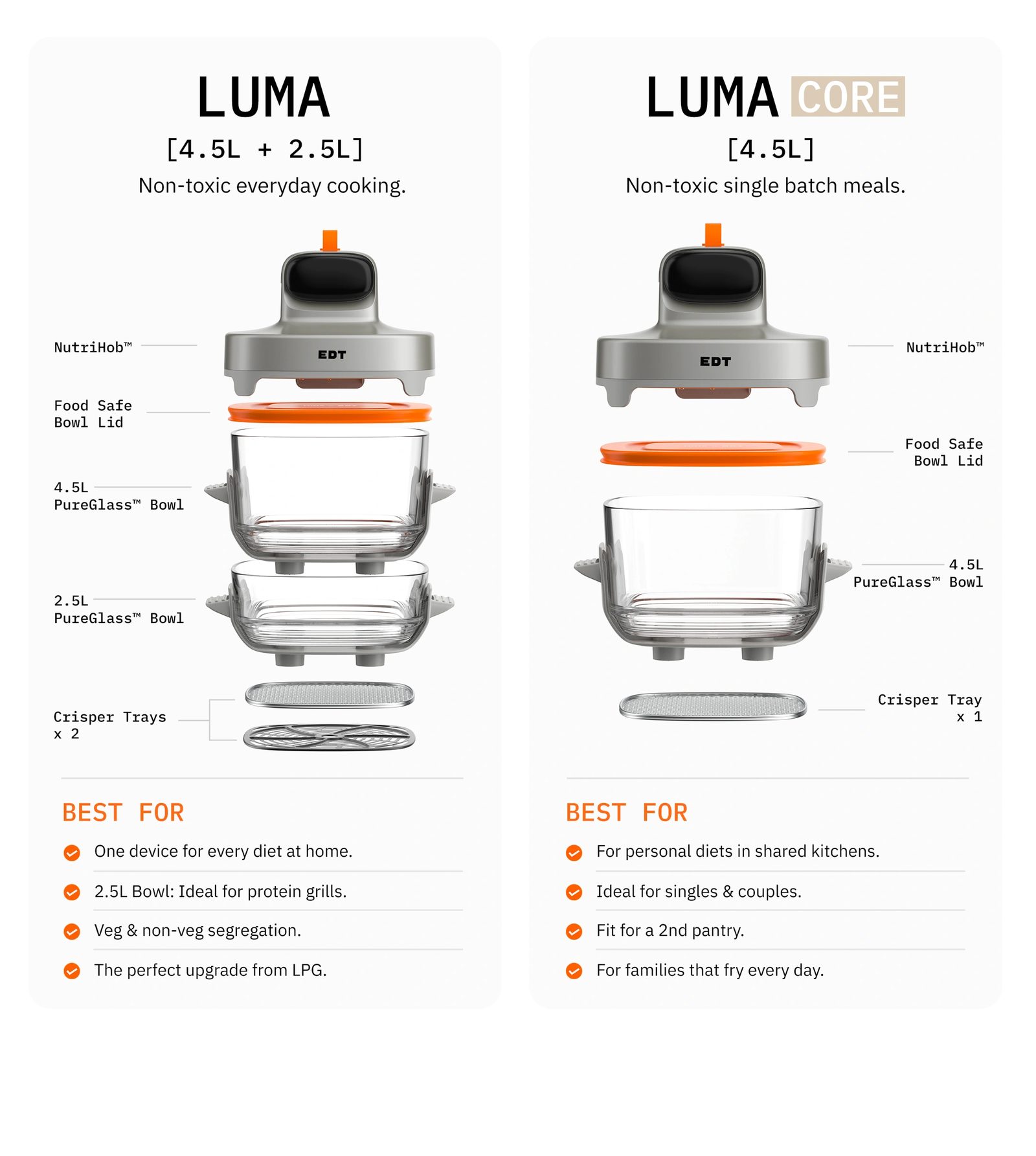
EDT LUMA and LUMA Core air fryers: the heating head (NutriHob), glass bowls (PureGlass), lids and crisper trays Source: EDT online store, LUMA product page
Independent report content
| ROUND | US$2.4m (about ₹21 crore) pre-Series A · announced 30 Sep 2026 · described as oversubscribed |
|---|---|
| LEAD | Sauce.vc (existing investor) |
| CO-INVESTORS | Existing angel investors; pre-seed backers included Consumer Collective, a Peak XV Spark grant and angels from CaratLane, Noise and Urban Company |
| TOTAL RAISED | About US$3.8m (pre-seed US$1.4m, Dec 2025; pre-Series A US$2.4m, Sep 2026) |
| VALUATION | Not disclosed |
| REVENUE | No filed accounts yet (first financial year ended Mar 2026); company says Amazon sales grew ~7x between Mar and Jul 2026 |
| KEY METRIC | 6,000+ LUMA users (company website, Nov 2026) |
| PRODUCTS AND PRICES | LUMA glass air fryer ₹8,999–12,199 · FLOW kettle ₹4,999 · SUKI hair dryer ₹8,999 · DIEM espresso machine ₹17,999 (D2C prices, Nov 2026) |
| CHANNELS | Own D2C site, Amazon, Flipkart, Blinkit, Croma, FoodStories |
| COMPANY | Edtlife Technology Pvt Ltd (database name) · Mumbai · founded 2025 by Naiyya Saggi (CEO) and Vyasateja Rao (chief design officer) |
| THE ACCESS POINT EDT is a private seed-stage company. Its institutional investor is Sauce.vc, a consumer-brand venture fund, alongside Consumer Collective and angel investors. Individual investors can reach EDT only through Sauce.vc's Category I or II AIF (if open), through participation as an angel in a future round, or through a negotiated transfer from an existing angel. There is no listed proxy. Listed appliance companies such as TTK Prestige, Stovekraft (Pigeon), Havells and Borosil offer sector exposure, not EDT exposure. |
|---|
Executive decision summary
| THE BOTTOM LINE EDT is an 18-month-old Mumbai appliance brand that sells design-first kitchen and beauty devices at premium prices. Its lead product, LUMA, is an air fryer that cooks in glass bowls instead of coated metal baskets, a direct answer to consumer worry about non-stick coatings. FLOW (a precision kettle), SUKI (a sensor-controlled hair dryer) and DIEM (an espresso machine launched in October 2026) followed within a year. The founders are a proven consumer-internet builder, Naiyya Saggi of BabyChakra and The Good Glamm Group, and an award-winning industrial designer, Vyasateja Rao. EDT has raised about US$3.8m. Traction is early: 6,000+ LUMA users and a seven-fold rise in Amazon sales between March and July 2026, but no published revenue. The question for investors is whether a small brand can keep launching hits in a category dominated by Philips, Havells and Prestige, while funding inventory with venture money. |
|---|
| WHICH INVESTOR EDT fits you IF you back founders early in consumer hardware, accept that most seed-stage appliance brands never reach scale, and can hold for 7–10 years through a consumer-focused fund or as an angel. Look elsewhere IF you need revenue, profits or a priced entry point. EDT has no filed accounts, has not disclosed its valuation and is spending on four product lines at once. |
|---|
| COMFORT FIT EDT = the boutique architect who designs one beautiful house at a time. Each product is a statement, but each also has to sell on its own. Philips, Havells, Prestige = the large builders with dealer networks in every town. Cheaper, everywhere, rarely exciting. Agaro, Wonderchef, Nuuk = other new-age brands chasing the same online kitchen shopper with wider ranges and lower prices. Dyson = the global proof that premium design in everyday appliances can command a high price, at the cost of decades of engineering spend. |
|---|
| THE RUPEIA NUMBER About 6,000 LUMAs, about ₹6 crore of sales. The website says LUMA has 6,000+ users. At ₹10,000–12,000 per unit including GST, that is roughly ₹5–6 crore of LUMA sales since launch (Rupeia calculation). EDT has raised about ₹33 crore. The company is still in its first year of turning investor money into products customers buy. |
|---|
1 CLAIM REGISTER: EVIDENCE GRADING
Every material claim in this note is graded by the strength of its published source. A = government, regulator or customer record. B = statutory filing or financial statement (including extracts). C = independent press. D = company announcement.
| Claim | Source | Grade | Rupeia assessment |
|---|---|---|---|
| US$2.4m pre-Series A led by Sauce.vc, oversubscribed | Inc42, Indian Retailer, YourStory (30 Sep 2026) | C | Established as an announced round. Allotment filing and valuation not public. |
| US$1.4m pre-seed led by Sauce VC with Consumer Collective, Peak XV Spark grant and angels | Indian Retailer, Venture Intelligence, Entrepreneur India (Dec 2025) | C | Established. |
| Founders Naiyya Saggi (CEO) and Vyasateja Rao (CDO), founded 2025 | Inc42, Indian Retailer, Indian Startup Times | C | Established across several outlets. |
| Saggi stepped away from her operating role at Good Glamm in 2025 | Indian Retailer; Mint via Inc42 | C | Established. The circumstances of her exit have been reported only briefly. |
| Amazon business grew ~7x between March and July 2026 | Company statement to Inc42 | D | Base not disclosed. A sevenfold rise from a small base is plausible for a new brand. |
| 6,000+ LUMA users | EDT website product page | D | Company marketing figure; definition (units sold or registered users) not stated. |
| Product prices, launch dates and range | EDT online store (product listings) | D (observable) | Directly observable list and selling prices, Nov 2026. |
| SUKI CareDry algorithm is patent-pending; sensors read 100 times a second | Company via Indian Retailer | D | No patent application number published. |
| Caitlin Kalinowski (hardware leader at OpenAI) joined the advisory board | Press coverage of pre-seed | C/D | Reported at launch; adviser role, not a shareholding disclosure. |
| Plans to sell in the GCC and US | Company via press | D | Intention only. |
2 COMPANY OVERVIEW & FOUNDING STORY
EDT stands for Everyday Design & Technology. It was founded in Mumbai in 2025 to make home and personal devices that are, in the company's words, contemporary, multifunctional, safe and intuitive. The company designs its products in India and uses manufacturing partners in India and abroad. It sells through its own website, Amazon, Flipkart, the quick-commerce app Blinkit, Croma stores and the kitchenware retailer FoodStories.
The founding insight is that Indian kitchens have bought small appliances on price and brand trust, not on design or materials. EDT's first product targeted a specific anxiety. Most air fryers cook food in a metal basket with a non-stick coating, and many buyers worry about coating wear at high temperatures. LUMA instead cooks in borosilicate-style glass bowls (PureGlass) with a heating head (NutriHob) that sits on top. The bowls double as serving and storage dishes with a lid.
The product range in November 2026
| Product | Category | First listed | Selling price (D2C) | Stated MRP |
|---|---|---|---|---|
| LUMA (4.5L + 2.5L glass bowls) | Air fryer oven | Sep 2025 listing; deliveries early 2026 | ₹11,999 | ₹14,999 |
| LUMA Core (4.5L) | Air fryer oven | Jul 2026 | ₹8,999 | ₹12,499 |
| LUMA Double Stack | Air fryer oven | Oct 2026 | ₹12,199 | ₹14,999 |
| FLOW | Precision electric kettle (glass) | Jul 2026 | ₹4,999 | ₹8,999 |
| SUKI | Hair dryer with CareDry sensors | Sep 2026 (pre-order ₹8,499) | ₹8,999 | ₹13,999 |
| DIEM | Espresso machine with steam wand | 30 Oct 2026 | ₹17,999 | ₹22,999 |
| Accessories | Spare glass bowls, grill rack, extended warranty | 2026 | ₹899–5,999 |
In about 13 months EDT moved from one product to four categories. That is fast for hardware. It shows design capacity but also spreads a small team and a small inventory budget across many lines.
3 TIMELINE: 2015–2026
| Date | Milestone |
|---|---|
| 2015 | Naiyya Saggi founds BabyChakra, a parenting community and commerce platform |
| 2021 | BabyChakra merges into MyGlamm; Saggi becomes a co-founder of The Good Glamm Group |
| 2025 | Saggi steps away from her operating role at Good Glamm; Mint reports she is starting a consumer-electronics business |
| 2025 | EDT founded in Mumbai by Saggi and Vyasateja Rao, founder of the industrial design studio Analogy |
| Sep 2025 | LUMA product page created on the EDT store (pre-launch) |
| Dec 2025 | EDT emerges from stealth with a US$1.4m pre-seed round led by Sauce VC; LUMA pre-orders and waitlist for Jan–Feb 2026 |
| Feb 2026 | Spare PureGlass bowls listed; LUMA deliveries under way |
| Mar–Jul 2026 | Amazon sales grow about 7x (company) |
| May–Jul 2026 | Combos, LUMA Core, FLOW kettle and grill rack launched |
| 25 Sep 2026 | SUKI hair dryer listed; EDT enters beauty tech |
| 30 Sep 2026 | US$2.4m pre-Series A led by Sauce.vc, oversubscribed |
| Oct 2026 | LUMA Double Stack and a free one-year extended warranty offer for the festive season |
| 30 Oct 2026 | DIEM espresso machine listed at ₹17,999 |
4 FUNDING HISTORY & INVESTOR BEHAVIOUR FORENSICS
| Date | Round | Amount | Investors (as reported) | Valuation |
|---|---|---|---|---|
| Dec 2025 | Pre-seed | US$1.4m (~₹12.5 crore) | Sauce VC (lead); Consumer Collective; Peak XV Spark grant; angels from CaratLane, Noise and Urban Company | Not disclosed |
| 30 Sep 2026 | Pre-Series A | US$2.4m (~₹21 crore) | Sauce.vc (lead, existing); existing angels | Not disclosed |
| Total | About US$3.8m (~₹33 crore) |
What the investor pattern shows
Sauce.vc doubled down. Sauce is one of India's most active consumer-brand funds. Leading both rounds shows conviction, but also that no new institutional lead priced the pre-Series A.
Operator angels. Angels from CaratLane (jewellery retail), Noise (consumer electronics) and Urban Company (home services) bring channel and supply-chain experience directly relevant to an appliance brand. Noise's co-founder Amit Khatri commented on the 2026 round.
Peak XV Spark grant. Spark is Peak XV's pre-seed programme. It gives Peak XV visibility into a possible later round but is not a lead commitment.
Oversubscribed but small. US$2.4m is modest for a hardware company with four product lines. The amount suggests EDT is raising in steps tied to inventory needs, which keeps dilution low but leaves little buffer.
| RUPEIA CALCULATION Seed-stage consumer brands in India commonly sell 10–20% in a pre-Series A. At those levels, US$2.4m would imply a post-money valuation of about US$12–24m (₹115–230 crore at ₹96 per US$). This is illustrative arithmetic, not a reported figure. |
|---|
5 FINANCIAL FORENSICS: WHAT CAN BE KNOWN
EDT has not yet filed accounts. Its first financial year ended on 31 March 2026, when LUMA deliveries had only just started. Those accounts are due with the registrar by around October–November 2026 and had not appeared in public databases by 6 November 2026. Public databases list two similar company names, Edtlife Technology Pvt Ltd and EDTLife Technologies Pvt Ltd; the legal issuer of the rounds should be confirmed against the allotment filing.
Estimating sales from what is published
| Product | Driver | Illustrative sales to date |
|---|---|---|
| LUMA family | 6,000+ users x ₹9,000–12,000 average selling price including GST | ₹5.4–7.2 crore gross |
| FLOW | Not disclosed; launched Jul 2026 at ₹4,999 | Not estimable |
| SUKI | Pre-orders from Sep 2026 | Not estimable |
| DIEM | Listed 30 Oct 2026 | nil to date |
| LUMA net of 18% GST | ₹5.4–7.2 crore ÷ 1.18 | ₹4.6–6.1 crore |
| RUPEIA READING Even generously counted, EDT's sales to date are probably below ₹10 crore against about ₹33 crore raised. For a first-year hardware brand that is normal. The point is that the investment case rests on future product hits, not on any business already proven. |
|---|
6 UNIT ECONOMICS: WHAT A LUMA MUST EARN
Appliance brands make or lose money on four lines: product cost, channel cost, marketing and after-sales service. EDT has published none of them. The table below shows how a ₹11,999 LUMA could split, using typical ranges for Indian consumer appliances. It is a framework for diligence, not EDT's actual numbers.
| Line per LUMA | Illustrative range | ₹ per unit (mid-point) | Comment |
|---|---|---|---|
| Selling price incl. GST | ₹11,999 | Observed D2C price | |
| Less GST at 18% | –₹1,830 | Net ₹10,169 | |
| Landed product cost (contract manufacturer, freight, duties, glass bowls) | 35–45% of net | –₹4,070 | Glass bowls and a heating head are heavier and costlier than a basket |
| Marketplace or retail margin | 0% (D2C) to 30% (retail) | –₹1,525 | Assumes a 15% blended channel cost |
| Shipping and packaging | 4–8% | –₹610 | Glass needs protective packaging; breakage risk |
| Returns and warranty reserve | 3–6% | –₹460 | One-year doorstep warranty across 19,000+ pincodes |
| Contribution before marketing | ~₹3,500 (34%) | Rupeia calculation | |
| Performance marketing | 15–30% | –₹2,290 | Typical for a new brand on marketplaces |
| Contribution after marketing | ~₹1,200 (12%) | Rupeia calculation; thin |
Reading the discounts
Every EDT product is listed with a strike-through MRP 20–45% above the selling price. FLOW sells at ₹4,999 against an MRP of ₹8,999. Festive extras such as a free extended warranty are also running. Heavy permanent discounting is common for new brands, but it trains customers to wait for offers. It also needs care under India's consumer-protection guidelines on misleading pricing (see the policy section).
7 CUSTOMER & CHANNEL INTELLIGENCE
| Channel | Status (Nov 2026) | Commercial reading |
|---|---|---|
| EDT D2C store | Full range; first channel for new launches (SUKI, DIEM) | Highest margin; dependent on paid social media |
| Amazon | Key channel; ~7x growth Mar–Jul 2026 | Volume and reviews; commission and advertising costs |
| Flipkart | Listed | Second marketplace; festive season weight |
| Blinkit | Listed | Quick commerce: impulse and gifting; small assortment |
| Croma | In-store demonstration | Lets customers see the glass bowls; retail margins and inventory risk |
| FoodStories | Listed | Premium kitchenware retail |
The customer EDT targets is an urban household, often a young couple or family, that cares about health and appearance and pays for design. Product copy points to separating vegetarian and non-vegetarian cooking (two bowls), cooking for singles and couples (LUMA Core) and replacing gas cooking. Website reviews highlight the absence of coatings and the visibility of food through glass.
| WHAT IS MISSING EDT has not disclosed repeat-purchase rates, the share of customers buying a second product, return rates or channel mix. For a multi-product brand, the share of LUMA buyers who later buy FLOW, SUKI or DIEM is the metric that would show whether EDT is building a brand or a series of one-off launches. |
|---|
8 MARKET & COMPETITIVE ANALYSIS
India's small kitchen appliance market is crowded at the low end and thin at the premium end. Air fryers moved from a niche to a mainstream online purchase after 2020. Most sell between ₹3,000 and ₹8,000. LUMA is priced above most mainstream models and competes on material safety and design rather than price.
| Company | Type | Overlap with EDT | Edge vs EDT |
|---|---|---|---|
| Philips (Versuni) | Global appliance brand | Air fryers, kettles, hair dryers | Category creator in air fryers; service network |
| Havells, Bajaj Electricals, Crompton | Listed Indian electricals | Kettles, air fryers, hair dryers | Dealer reach; trusted service |
| TTK Prestige, Stovekraft (Pigeon) | Listed kitchen brands | Air fryers, kettles | Kitchen brand trust, low cost |
| Borosil | Listed glassware and appliances | Glass cookware; small appliances | Glass brand trust in Indian homes |
| Wonderchef, Agaro, Inalsa | Private appliance brands | Air fryers, kettles, beauty | Wide ranges, aggressive online pricing |
| Nuuk | D2C appliance brand | Design-led home appliances | Reported to be raising ~₹100 crore at ~₹500 crore valuation (2026) |
| Dyson, Philips, Agaro (beauty) | Hair-care devices | SUKI | Dyson owns the premium hair dryer price point |
| De'Longhi, Philips, Agaro (coffee) | Espresso machines | DIEM | Established coffee machine reputations and service |
Listed benchmarks
| Listed company | Why it matters for EDT |
|---|---|
| TTK Prestige | Shows the margins and growth of a pure kitchen brand |
| Stovekraft (Pigeon, Gilma) | Shows low-price volume economics |
| Borosil | Glass trust is EDT's core proposition; Borosil is a natural acquirer or competitor |
| Havells, Bajaj Electricals | Show what it costs to build service and distribution at scale |
EDT's position is premium design at a mid-to-premium price. The nearest private comparison on positioning is Nuuk. The nearest public proof that Indian consumers pay for glass in the kitchen is Borosil.
9 MOAT ANALYSIS: WHAT PROTECTS EDT, AND FOR HOW LONG
| Moat source | Strength | Durability | Comment |
|---|---|---|---|
| Industrial design capability | Medium–strong | Medium | Rao's studio background; distinctive products. Designs can be imitated within one or two seasons |
| Glass-bowl air-fryer format | Medium | Short–medium | Clear differentiation today; incumbents can launch glass formats quickly |
| Patent-pending CareDry algorithm (SUKI) | Weak–medium | Unknown | No published application number; software features are hard to protect |
| Brand and founder visibility | Medium | Medium | Saggi's profile helps press and early demand |
| Channel relationships | Weak | Short | Marketplaces and Croma are open to every brand |
EDT's real moat, if it develops, would be a design-and-launch engine that produces a new hit every year and a customer base that buys across categories. Neither is proven after one year.
10 FOUNDERS' PATH
Naiyya Saggi, co-founder and CEO
Saggi studied law and later took an MBA at Harvard Business School on a full scholarship, according to her own public statements. She returned to India and in 2015 founded BabyChakra, a parenting content and commerce platform. In 2021 BabyChakra merged into MyGlamm, and Saggi became a co-founder of The Good Glamm Group, the beauty and content conglomerate. She was named in ET's 40 under 40 (West, 2025). In 2025 she stepped away from her operating role at Good Glamm, which had come under financial strain, and Mint reported she was starting a consumer-electronics business.
Vyasateja Rao, co-founder and chief design officer
Rao is an industrial designer who founded and ran the design studio Analogy before EDT. Press reports describe him as award-winning. His studio background explains EDT's ability to bring finished-looking products to market quickly.
What the path tells an investor
Complementary pair. A consumer-internet operator who has raised large rounds, paired with a hardware designer. That is the right shape for a design-led appliance brand.
Good Glamm is a double-edged reference. It shows Saggi can build and scale consumer businesses and raise capital. It also means investors will ask how lessons from an over-extended, acquisition-led group apply to EDT's fast product expansion.
First hardware company for the CEO. BabyChakra and Good Glamm were content and beauty-commerce businesses. Inventory, tooling, certification and warranty service are new disciplines.
11 TEAM, GOVERNANCE & PEOPLE
| Role | Name | Note |
|---|---|---|
| Co-founder & CEO | Naiyya Saggi | Ex-BabyChakra founder; ex-Good Glamm co-founder |
| Co-founder & Chief Design Officer | Vyasateja Rao | Founder of design studio Analogy |
| Adviser | Caitlin Kalinowski | Reported at launch as hardware leader at OpenAI; adviser role |
| Teams being built (Sep 2026) | Growth, supply chain, brand and product | Stated use of the pre-Series A money |
Governance reading: a seed-stage company with no published board. Sauce.vc probably holds a nominee or observer seat. The most important governance questions are inventory controls, supplier contracts and quality testing, all of which matter more in hardware than in software.
12 POLICY & REGULATORY SURFACE
| Rule | What it requires | Effect on EDT |
|---|---|---|
| BIS certification and Quality Control Orders | Many household electrical appliances need BIS safety certification (IS 302 series) before sale | Each new product needs testing and registration; timing risk for launches |
| Legal Metrology (Packaged Commodities) Rules | MRP, manufacturer or importer details and country of origin on the pack | Imported or contract-made products must label origin |
| Consumer Protection Act 2019; CCPA dark-pattern guidelines (2023) | No misleading discounts, false urgency or drip pricing | Strike-through MRPs and festive offers must reflect genuine reference prices |
| Consumer Protection (E-Commerce) Rules | Seller details, return and grievance policies | Applies to the D2C store |
| E-waste (Management) Rules 2022 | Extended producer responsibility for electrical products | Registration and recycling targets as volumes grow |
| Customs duties and import rules | Duties on finished appliances and components | Affects cost if manufacturing partners are abroad |
Policy is a cost of doing business for EDT rather than a growth driver. The government's push for domestic electronics manufacturing could favour EDT if it shifts more production to Indian partners, which it has said it plans to do.
13 VALUATION ANALYSIS
EDT has not disclosed a valuation. The table shows the post-money valuation implied by different stakes sold in the pre-Series A, and what that would mean against Rupeia's sales estimate.
| If US$2.4m bought… | Implied post-money | In ₹ (at ₹96) | x illustrative sales to date (~₹6 crore) |
|---|---|---|---|
| 10% | US$24m | ₹230 crore | ~38x |
| 15% | US$16m | ₹154 crore | ~26x |
| 20% | US$12m | ₹115 crore | ~19x |
| RUPEIA READING Listed Indian appliance companies typically trade at 2–6x revenue. Seed-stage consumer brands are priced on founder quality and launch momentum, not revenue. Any secondary price should be checked against the allotment price in the PAS-3 filing for the September 2026 round. |
|---|
14 SCENARIO ANALYSIS
| Scenario | Probability (Rupeia) | What has to happen | Sales by FY28 | Outcome |
|---|---|---|---|---|
| Bull | 20% | LUMA becomes a top-10 premium air fryer online; SUKI or DIEM becomes a second hit; repeat buyers exceed 15%; Series A of US$10m+ | ₹100 crore+ | Series A at a large step-up; strategic interest from Borosil, Havells or Prestige |
| Base | 45% | LUMA sells steadily; one of the newer lines works; inventory managed | ₹30–60 crore | Series A at a modest step-up; long road to profit |
| Bear | 35% | Incumbents launch glass air fryers at lower prices; new lines dilute focus; inventory write-downs | <₹20 crore | Down round, acqui-hire or wind-down |
The bear case carries a high probability because consumer hardware has a high failure rate at this stage. Inventory is the usual cause of death: a brand orders ahead of festive demand, demand falls short, and cash is locked in unsold stock.
15 ENTRY MATHS FOR AN ANGEL OR SECONDARY BUYER
| Entry post-money | Exit value (2032) | Gross multiple | Approximate IRR (6 years) |
|---|---|---|---|
| ₹150 crore | ₹1,000 crore (sale to strategic) | 6.7x | ~37% |
| ₹150 crore | ₹400 crore | 2.7x | ~18% |
| ₹150 crore | ₹150 crore | 1.0x | 0% |
| ₹150 crore | Wind-down | 0x | –100% |
A seed investor in consumer hardware should expect most bets to return little and a few to return a lot. EDT should be sized as one position in a portfolio of early consumer bets, not as a single large holding.
16 EXIT ANALYSIS
| Route | Likelihood (6–8 yrs) | Precedent | Comment |
|---|---|---|---|
| Sale to a listed Indian appliance or glassware company | Medium | Indian consumer majors buying digital-first brands | Borosil, Havells, Prestige or Crompton could buy design capability and an online customer base |
| Sale to a consumer conglomerate or brand roll-up | Medium | Brand aggregators and FMCG venture arms (e.g. Wipro Consumer Care Ventures backing Nuuk) | Price depends on profitability |
| Indian IPO | Low | Few D2C appliance brands have listed | Needs ₹300 crore+ revenue and profits |
| Secondary at Series A or B | Medium | Common for angels | The most realistic early liquidity |
17 RISK ANALYSIS: RED FLAG LEDGER & KILL CONDITIONS
| Risk | Severity | Evidence | Kill condition |
|---|---|---|---|
| Inventory and working capital | High | Round raised to build festive inventory; four product lines | Inventory days above 150 or write-downs in FY27 accounts |
| Product spread | High | Four categories in 13 months on ~₹33 crore raised | No single line passes ₹20 crore annual sales by FY28 |
| Copycat risk | Medium | Glass air fryer format easy for incumbents to adopt | Two or more major brands launch glass-bowl air fryers below ₹8,000 |
| Discount dependence | Medium | Strike-through MRPs 20–45% above selling prices | Sales fall sharply when offers stop |
| Quality and safety | Medium | Glass bowls in a heated appliance; one-year doorstep warranty | Product recall, BIS issue or rise in warranty claims |
| Founder track record questions | Medium | Good Glamm's 2025 strain | Governance concerns raised by new investors |
| Capital access | Medium | Only Sauce led both rounds | No new institutional lead by end-2027 |
18 INVESTOR CLASS ANALYSIS
For HNIs
The practical routes are an angel cheque in the next round, if offered, or a commitment to a consumer-focused AIF such as Sauce.vc's funds. Size it as a small, high-risk position.
For family offices
Family offices with a consumer-durables or retail business could add value as strategic angels (manufacturing, distribution). Diligence should cover FY26 and FY27 accounts, inventory ageing, supplier contracts and return rates.
For institutions
Too early for most institutions. Corporate venture arms of appliance or glassware companies could consider a minority stake with a right of first offer.
For NRIs
Unlisted shares can be held under FEMA non-debt instrument rules. The company's plans for the GCC and US may interest Gulf-based NRIs as potential distribution partners.
19 COMFORT FIT: THE DECISION PAGE
| If you want… | Best fit | Why | Caution |
|---|---|---|---|
| Seed-stage design-led consumer hardware | EDT (via angel cheque or Sauce.vc fund) | Strong founder pair; distinctive products | No accounts; high failure rate |
| Listed Indian kitchen appliances | TTK Prestige, Stovekraft | Profitable, disclosed | Lower growth; price competition |
| Listed electrical consumer durables | Havells, Crompton, Bajaj Electricals | Scale, service network | Not design-led |
| Glass in the Indian kitchen | Borosil | Listed glass brand trust | Different product mix |
20 THE EARLY SIGNAL: EVENTS TO WATCH
| When | Event | Why it matters |
|---|---|---|
| Nov 2026–Jan 2027 | FY26 accounts appear in MCA databases | First look at revenue, losses and inventory |
| Q4 2026 | PAS-3 allotment filing for the US$2.4m round | Reveals price per share and valuation |
| Nov 2026–Jan 2027 | Festive-season sell-through | Shows whether inventory bought with the round turned into sales |
| 2027 | SUKI and DIEM on marketplaces and in Croma | Tests whether EDT can repeat LUMA's launch beyond its first category |
| 2027 | A new institutional lead for a Series A | Independent validation of price and traction |
| Ongoing | Glass-bowl air fryers from Philips, Prestige or Borosil | The clearest competitive threat |
21 RUPEIA FINAL INDEPENDENT VIEW
EDT has done what seed-stage hardware companies rarely do in their first year. It has shipped four distinct, well-designed products and placed them on every major Indian sales channel. LUMA's glass-bowl format answers a real consumer worry, and the founders combine consumer-internet scale-up experience with serious industrial design. The investor base is supportive and has operator angels relevant to retail and electronics.
Against that, the business is still a set of launches rather than a proven brand. Sales are probably in single-digit crores, no accounts are public, discounts are deep, and four product lines are competing for about ₹33 crore of capital. The next 12 months will show whether festive inventory sells through and whether LUMA buyers come back for SUKI, FLOW or DIEM.
| THE RUPEIA NUMBER 6,000+ LUMAs. EDT needs ten times that within two years to become a meaningful kitchen brand. |
|---|
| RUPEIA VERDICT A promising founder-and-design bet at the earliest stage. Suitable only as a small position within a diversified early-stage consumer portfolio. Wait for FY26 and FY27 accounts and a new institutional lead before paying any premium. |
|---|
Frequently asked questions
What is EDT?
EDT (Everyday Design & Technology) is a Mumbai consumer-appliance brand founded in 2025. It makes the LUMA glass air fryer, the FLOW kettle, the SUKI hair dryer and the DIEM espresso machine.
How much funding has EDT raised?
About US$3.8m: a US$1.4m pre-seed in December 2025 and a US$2.4m pre-Series A in September 2026, both led by Sauce.vc.
Who founded EDT?
Naiyya Saggi, founder of BabyChakra and co-founder of The Good Glamm Group, and Vyasateja Rao, an industrial designer who founded the studio Analogy.
What is EDT's valuation?
Not disclosed. Rupeia's illustrative arithmetic suggests US$12–24m post-money if the 2026 round sold 10–20%, but this is not a reported figure.
How much does the EDT LUMA air fryer cost?
On EDT's own store in November 2026, LUMA with two glass bowls sold for ₹11,999 and LUMA Core with one 4.5L bowl for ₹8,999.
Why does LUMA use glass?
LUMA cooks in glass bowls instead of a coated metal basket, to avoid non-stick coatings. The bowls also work as serving and storage dishes.
Where can I buy EDT products?
On EDT's website, Amazon, Flipkart, Blinkit, Croma and FoodStories.
Who are EDT's competitors?
Philips, Havells, Prestige, Pigeon, Borosil, Wonderchef, Agaro, Inalsa and Nuuk in kitchen appliances, and Dyson and Philips in hair dryers.
Can I invest in EDT?
Not through a public market. Exposure is possible through Sauce.vc's funds, as an angel in a future round, or through a negotiated transfer from an existing shareholder.
Source log
Inc42: Consumer appliance startup EDT raises $2.4 Mn to expand product portfolio (30 Sep 2026)
Indian Retailer: Consumer electronics brand EDT raises funding ahead of festive season (30 Sep 2026)
YourStory: Startup news and updates, daily roundup (30 Sep 2026)
CXO Digital Pulse: Kitchen appliance startup EDT raises $2.4 million led by Sauce VC
Indian Retailer: Consumer appliances startup EDT raises $1.4 Mn in pre-seed funding (Dec 2025)
Venture Intelligence: Consumer appliances brand EDT raises $1.4m led by Sauce VC (Dec 2025)
Entrepreneur India: EDT and Lawyered raise early-stage funding (Dec 2025)
Marca Money: EDT raises $1.4 million in pre-seed funding led by Sauce VC (16 Dec 2025)
Inc42: The Good Glamm Group co-founder Naiyya Saggi eyes new venture in consumer electronics (2025)
Indian Startup Times: How Naiyya Saggi is building EDT (interview)
Business Today: Naiyya Saggi recalls her return to India (18 Aug 2026)
ET Edge: 40 under 40, West edition 2025 (Naiyya Saggi) (2025)
EDT online store: LUMA product page
EDT online store: SUKI product page
EDT online store: DIEM coffee machine (30 Oct 2026)
EDT online store: FLOW kettle
IPO Platform: EDT (Edtlife Technology Pvt Ltd) funding profile
Inc42: EDT company profile
Central Consumer Protection Authority: Guidelines for Prevention and Regulation of Dark Patterns, 2023 (2023)
Bureau of Indian Standards: Compulsory Registration Scheme and Quality Control Orders
| DISCLAIMER This report is independent research by Rupeia Investments Co. built only from public sources as of the date shown. It is not an offer, solicitation or investment advice, and it is not a recommendation to buy or sell any security. Private-company figures are drawn from filings and media reports and may be revised. Unlisted and private-market investments are illiquid and carry a risk of total loss. Investors should take independent advice. |
|---|