Digantara: US$50 million Series B (December 2025)

Anirudh Sharma, founder and CEO, Digantara Source: TechCrunch, December 2025
Independent report content
| SERIES B | US$50 million equity, 16 Dec 2025; new investors 360 ONE Asset, SBI Investment (Japan), Ronnie Screwvala; Peak XV and Kalaari existing; Reliance named as lead by one outlet (RoC filing) |
|---|---|
| TOTAL RAISED | About US$64.5 million over 11 rounds (TechCrunch; CB Insights) |
| VALUATION | About US$200 million post-money (one outlet); about US$69–71 million at Series A-II (CB Insights) |
| REVENUE | Grown more than tenfold in two years (CEO); not disclosed; target US$25–30 million a year within 18 months; CB Insights US$30 million is likely the target |
| CONTRACTS | About US$25 million combined (TechCrunch); US Space Command analytics contract; US entity on the Missile Defense Agency SHIELD vehicle; Indian defence tenders won, formalities pending |
| TEAM | About 125 employees, 80–85 engineers; India, Singapore and the US; Europe entity planned for 2026 |
| PLAN | 15 space-surveillance satellites and 2 missile-warning satellites over 2026–27; SpaceX rideshare launches planned for March, June and October 2026 (not verified) |
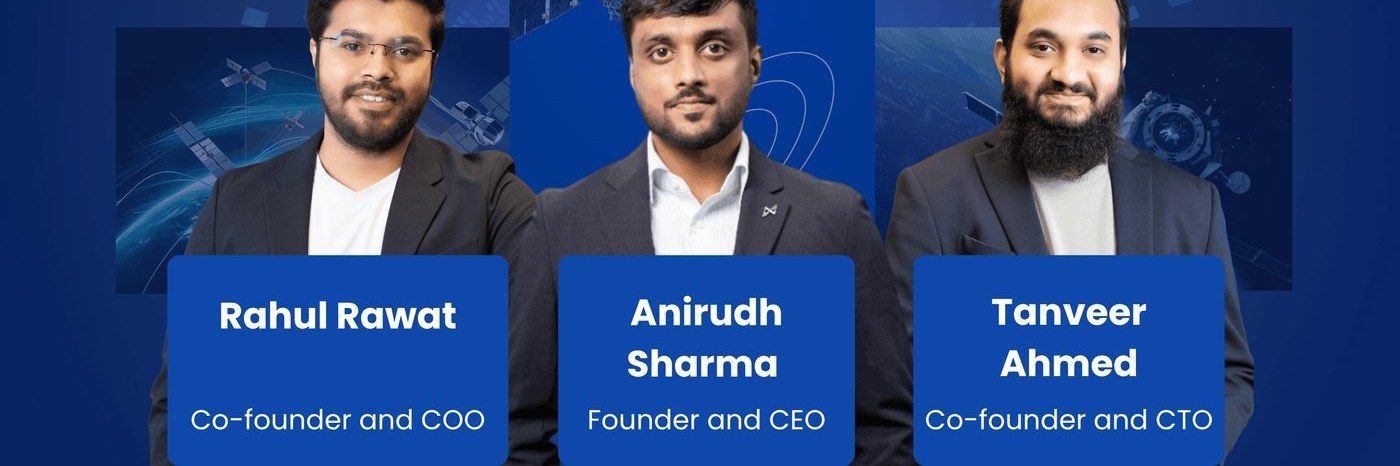
| FOUNDERS | Anirudh Sharma (CEO), Rahul Rawat and Tanveer Ahmed; founded 2020 per most sources (2018 per Entrackr) |
| THE ACCESS POINT Digantara is a venture-backed private company with no IPO plans. Reliance, Peak XV and Kalaari are the visible institutional holders. |
|---|
Executive decision summary
| THE BOTTOM LINE Digantara tracks objects in orbit, mainly to warn operators of collisions and, increasingly, to give defence customers early warning of missiles. It raised US$50 million in a Series B in December 2025, bringing total funding to about US$64.5 million, with Reliance reported as lead by one outlet. The company says revenue grew more than tenfold in two years and expects US$25–30 million within 18 months, backed by about US$25 million of contracts including a US Space Command analytics deal. Its public record includes no revenue figure, a single-source valuation of about US$200 million, unresolved conflicts about its founding year, satellite count and sensor type, and no confirmation that its 2026 launches took place. The thesis is defence demand for space-based sensing; the risk is that commercial demand is "insignificant" and defence orders are lumpy. |
|---|
| WHICH INVESTOR Fits you IF you want to follow India's emerging defence-space companies through a start-up with US and Indian government customers. Look elsewhere IF you want audited financials or a listing route: neither exists, and 2026 launch success is unconfirmed. |
|---|
| COMFORT FIT Digantara = a company that watches space itself: it tracks satellites and debris and is moving to spot missile launches. Slingshot Aerospace, Vyoma, Odin Space = competitors listed by CB Insights. Skyroot, Agnikul, Pixxel, Dhruva Space = other Indian space companies, in this archive or in the sector list. |
|---|
| THE RUPEIA NUMBER US$25 million. Combined value of Digantara's contracts as stated by TechCrunch, against a valuation of about US$200 million. |
|---|
1 CLAIM REGISTER: EVIDENCE GRADING
A = government or regulator record. B = statutory filing. C = independent press. D = company announcement.
| Claim | Source | Grade | Rupeia assessment |
|---|---|---|---|
| US$50 million Series B, 16 Dec 2025; investors 360 ONE, SBI Investment Japan, Ronnie Screwvala, Peak XV, Kalaari | TechCrunch; Entrackr; CB Insights | B | Established. |
| Reliance Industries led the round | Entrepreneur India (2 Feb 2026, citing RoC filing) | C | Single source; not in TechCrunch list. |
| Post-money about US$200 million | Entrepreneur India | C | Not confirmed elsewhere. |
| Total raised about US$64.5 million; 11 rounds | TechCrunch; CB Insights | B | Agree. |
| Contracts about US$25 million; US Space Command; Missile Defense Agency SHIELD vehicle | TechCrunch | C | CEO statements. |
| Revenue more than tenfold in two years; target US$25–30 million in 18 months | TechCrunch | C | No actual figure. |
| CB Insights lists 2026 revenue of US$30 million | CB Insights | D | Probably the target. |
| SCOT satellite launched Jan 2025 on SpaceX Transporter-12 | TechCrunch | C | Entrepreneur says three satellites in orbit. |
| Founded 2020 vs 2018 | TechCrunch; Outlook; Entrepreneur vs Entrackr | C | Conflict. |
2 COMPANY OVERVIEW & FOUNDING STORY
Digantara was founded in Bengaluru by Anirudh Sharma (CEO), Rahul Rawat and Tanveer Ahmed. Most sources say it was founded in 2020 (Entrepreneur: December 2020); Entrackr says 2018. It runs a platform called AIRA that combines sensing hardware, data processing and analytics, a satellite series (SCOT, Space Camera for Object Tracking), a planned ALBATROSS series for missile warning and a SKYGATE network of ground sensors.
The company has about 125 employees, 80–85 of them engineers, a 25,000 sq ft plant that can build up to five satellites at once, and a memorandum with Andhra Pradesh for a larger facility for up to 30 satellites at once. It operates in India, Singapore and the US (a Colorado Springs office opened around February 2025) and plans a European entity in 2026.
Customers are mainly defence and government. The CEO has said commercial demand is "quite insignificant". The strategy has moved from pure space situational awareness (collision warnings) towards a full-stack surveillance and early-warning business.
3 TIMELINE
| Date | Event |
|---|---|
| 2020 (or 2018) | Founded in Bengaluru |
| Jul 2021 | Kalaari invests (seed) |
| Jun 2023 | US$10 million Series A led by Peak XV and Kalaari |
| Feb 2024 | Series A-II: Aditya Birla Group and SIDBI Venture Capital (valuation about US$69–71 million, CB Insights) |
| Jan 2025 | SCOT satellite launched on SpaceX Transporter-12 |
| Feb 2025 | Colorado Springs office opens |
| 16 Dec 2025 | US$50 million Series B |
| 2026–27 | Planned 15 surveillance and 2 missile-warning satellites; European entity |
4 FUNDING HISTORY AND VALUATION
| Round | Investors | Amount | Comment |
|---|---|---|---|
| Seed (2021) | Kalaari Capital | Not found | First investment 15 Jul 2021 (CB Insights) |
| Series A (Jun 2023) | Peak XV, Kalaari | US$10 million (~₹97 crore) | TechCrunch calls it A1 |
| Series A-II (Feb 2024) | Aditya Birla Group, SIDBI VC | Not found | Valuation about US$69–71 million (CB Insights) |
| Series B (Dec 2025) | 360 ONE, SBI Investment Japan, Ronnie Screwvala, Peak XV, Kalaari; Reliance reported as lead | US$50 million (~₹483 crore) | Valuation about US$200 million post-money (one source) |
| Total | 11 rounds, 17 investors | ~US$64.5 million (~₹622 crore) | TechCrunch; CB Insights |
TechCrunch splits use of the Series B: US$7–10 million for US expansion, US$2–3 million for Europe and the rest for India manufacturing and operations.
| RUPEIA CALCULATION If the Series B was struck at about US$150 million pre-money and US$200 million post-money, the round bought 25% of the company (50 ÷ 200). The step-up from about US$70 million at Series A-II to US$200 million is 2.9 times in 22 months. Total funding of US$64.5 million is about 32% of the post-money valuation. At the target of US$25–30 million of annual revenue the valuation would be 6.7–8.0 times (200 ÷ 30; 200 ÷ 25), and against the US$25 million of contracts, 8.0 times. All of this rests on a single-source valuation. |
|---|
5 FINANCIAL FORENSICS: TARGETS, NOT RESULTS
| Metric | Figure | Source | Comment |
|---|---|---|---|
| Revenue growth | More than tenfold over two years | CEO, TechCrunch | Base year not stated |
| Revenue today | Not disclosed | — | — |
| Revenue target | US$25–30 million a year within 18 months | TechCrunch | Forward-looking |
| Contracts | ~US$25 million combined | TechCrunch | Duration not stated |
| CB Insights "2026 revenue" | US$30 million | CB Insights | Matches the top of the target; treated as unverified |
| Headcount | ~125 (80–85 engineers) | TechCrunch | Dec 2025 |
No accounts are public. The company has said that revenue is mostly from defence and government, which implies long procurement cycles and uneven recognition.
| RUPEIA CALCULATION What the US$25–30 million target requires. If current revenue were US$5 million (a Rupeia assumption; none is disclosed), reaching US$25–30 million in 18 months means growth of 5–6 times, or an annualised 2.9–3.4 times (5^(1/1.5) = 2.9; 6^(1/1.5) = 3.3). The "tenfold in two years" claim implies 3.2 times a year. So the plan assumes the same growth pace continues, which is plausible for a small base and hard for a larger one. |
|---|
6 BUSINESS MODEL & UNIT ECONOMICS
Digantara sells data, analytics and sensing services for tracking objects in space, mainly to defence and government buyers.
| Line | How it earns | Pressure point |
|---|---|---|
| Space situational awareness analytics | Tracking of satellites and debris; analytics as a service (US Space Command) | Competition from Slingshot and others |
| Own surveillance satellites (SCOT series) | Data from orbit; 15 planned in 2026–27 | Launch dependence; capital |
| Missile warning (ALBATROSS) | Two satellites planned; IR sensing | Technical and political risk |
| Ground sensors (SKYGATE) | Network of ground-based sensors | Operating cost |
| Defence contracts (India, US, Singapore) | Tenders and framework vehicles; DSTA partnership | Procurement timing |
Space surveillance is a data business with high capital needs up front. Defence buyers prefer locally built systems, so Digantara builds separately in each market (TechCrunch).
7 MARKET & COMPETITIVE ANALYSIS
| Peer | Status | Position |
|---|---|---|
| Slingshot Aerospace | US private | Competitor listed by CB Insights |
| Vyoma, Odin Space, GuardianSat, SpaceAble, Aldoria | European private | CB Insights competitor list |
| Pixxel, Agnikul, Skyroot, Dhruva Space, SatSure | Indian space companies | Sector peers in Entrackr; not SSA competitors |
| Agnikul, Parsec Aerospace, CosmoServe | Reports 49–51 in this archive | Launch and space-infrastructure peers |
Space situational awareness is a small and young market; the sources do not provide market size or competitor revenues.
8 1. WHAT SPACE SITUATIONAL AWARENESS IS, IN PLAIN TERMS
Thousands of satellites and pieces of debris orbit the Earth. Operators need to know where they are to avoid collisions; militaries need to know who else is in orbit and where missiles are launched. Digantara's first product tracked objects using its own space camera and data from partners; its newer plans add infrared sensors for missile warning, LiDAR-based debris monitoring (Kalaari) and a network of ground sensors.
| Capability | What it does | Buyer |
|---|---|---|
| Object tracking (SCOT) | Cameras in orbit see objects, including small debris | Satellite operators, defence |
| Collision warnings | Analytics on orbits | Satellite owners |
| Missile warning (planned) | Infrared detection of launches from orbit | Defence ministries |
| Ground sensors (SKYGATE) | Telescopes and radar on Earth | Defence and commercial |
Descriptions follow TechCrunch, Entrackr, Entrepreneur India and Kalaari; sensor type is described as IR by TechCrunch and LiDAR by Kalaari.
9 2. CONTRACTS AND CUSTOMERS
| Item | Detail | Source |
|---|---|---|
| US Space Command | Analytics-as-a-service contract | TechCrunch |
| Missile Defense Agency | US entity selected for the SHIELD contract vehicle | TechCrunch |
| Golden Dome programme | Entrepreneur India says selected to participate; not corroborated | Entrepreneur India |
| India | Winning bidder in defence tenders; formalities pending | TechCrunch (CEO) |
| Singapore | DSTA partnership on SSA software tools | Entrepreneur India |
| Total value | About US$25 million combined | TechCrunch |
| Commercial | "Quite insignificant" | Outlook Business |
Government and defence contracts typically pay in tranches over several years; US$25 million of contracts does not mean US$25 million of annual revenue.
10 3. THE SATELLITE PLAN AND LAUNCH RISK
| Item | Reported | Note |
|---|---|---|
| SCOT launched | January 2025, SpaceX Transporter-12 | Entrepreneur says three satellites in orbit; sources differ on mission types |
| 2026 launches | March, June and October 2026 planned (TechCrunch) | No source confirms they occurred |
| Planned fleet | 15 surveillance + 2 missile-warning satellites, 2026–27 | Entrackr; TechCrunch says 15 total |
| Satellite class | 100 kg (TechCrunch) or up to 150 kg (Outlook) | Conflict |
| Manufacturing | 25,000 sq ft plant, five at once; AP facility up to 30 at once | TechCrunch |
| RUPEIA CALCULATION Rupeia calculation: 17 satellites over two years at an assumed US$2–3 million each (a Rupeia assumption; costs are not disclosed) would be US$34–51 million, about the whole of the US$50 million Series B before any other spending. The plan therefore depends on further funding or customer-funded satellites. |
|---|
11 4. VALUATION AND FUNDING SENSITIVITY
| Valuation (US$ million) | ₹ crore at ₹96.5 | x US$25 million contracts | x US$30 million target revenue |
|---|---|---|---|
| 100 | ~965 | 4.0x | 3.3x |
| 150 | ~1,450 | 6.0x | 5.0x |
| 200 (reported post-money) | ~1,930 | 8.0x | 6.7x |
| 300 | ~2,895 | 12.0x | 10.0x |
Rupeia arithmetic; the US$200 million figure is from a single outlet.
The multiples are modest for a defence-technology company only if the revenue target is achieved. If current revenue is a fraction of the target, the valuation is a bet on contract conversion.
12 5. GOVERNANCE AND INFORMATION GAPS
Founders: Anirudh Sharma (CEO, named throughout); Rahul Rawat and Tanveer Ahmed appear only in a Kalaari caption.
Lead investor: Reliance is named only by Entrepreneur India, citing a Registrar of Companies filing.
Founding year: 2020 (TechCrunch, Outlook body, Entrepreneur) or 2018 (Entrackr).
Satellite details: count in orbit, mission types, sensor type (IR or LiDAR) and class differ by source.
Golden Dome: participation claim not corroborated.
Not found: seed and A-II amounts, actual revenue, post-December-2025 headcount, 2026 launch confirmation.
13 6. POLICY CONTEXT
Outlook Business places Digantara in the context of the Indian Space Policy 2023 and Make in India for space, which opened the sector to private players. US buyers prefer domestically built systems, which is why Digantara has a US entity and plans a European one. The sources do not quote a policy text; the more concrete point is that India has made space-based defence sensing a stated priority, and the US has opened frameworks (SHIELD) to non-US entities with a US footprint.
14 7. RISK MAP
| Risk | Mechanism | What to watch |
|---|---|---|
| Launch risk | Satellites depend on rideshare launches | Confirmation of 2026 launches |
| Defence concentration | Commercial demand is small | Contract awards |
| Lumpy revenue | Tranche-based contracts | Revenue disclosure |
| Capital needs | 17 satellites plus facilities | Next funding round |
| Technical claims | Sensor and capability claims differ by source | Independent validation |
| Geopolitics | US and Indian procurement rules | Contract status |
| Single-source valuation | US$200 million not confirmed | Filed round terms |
15 8. QUESTIONS AN INVESTOR SHOULD ASK
Revenue and backlog by customer, with contract tenors.
Which 2026 launches took place and what the fleet in orbit is today.
Series B terms: lead investor, valuation and use of funds.
Satellite cost and funding for the 17-satellite plan.
Missile-warning technical roadmap and sensor type.
Terms of the US Space Command and SHIELD arrangements.
India contract formalities and timing.
Commercial revenue share.
16 9. GLOSSARY
| Term | Meaning |
|---|---|
| SSA | Space situational awareness |
| SCOT | Space Camera for Object Tracking |
| IR / LiDAR | Infrared sensing / laser-based ranging |
| SHIELD | US Missile Defense Agency contract vehicle |
| Rideshare | Sharing a launch with other payloads |
| Analytics as a service | Selling processed data and analysis, not hardware |
17 VALUATION SCENARIOS (ILLUSTRATIVE)
| Scenario | Value (US$ million) | ₹ crore | What must be true |
|---|---|---|---|
| Bear | 100 | ~965 | Launch delays; defence orders slip |
| Base | 200 | ~1,930 | Series B mark holds; revenue approaches US$15–20 million |
| Bull | 350 | ~3,380 | Missile-warning wins and revenue near US$30 million |
Rupeia scenarios; only the US$200 million mark is reported.
18 SCENARIO ANALYSIS
| Scenario | Probability | What happens |
|---|---|---|
| Bull | 20% | Launches succeed; revenue approaches US$25–30 million by 2028 |
| Base | 45% | Slower launches; revenue US$10–15 million; follow-on round |
| Bear | 35% | Launch failure or contract delay; down round |
19 RISK ANALYSIS: RED FLAG LEDGER & KILL CONDITIONS
| Risk | Severity | Kill condition |
|---|---|---|
| Launch and satellite risk | High | Launch confirmations |
| Defence dependence and lumpiness | High | Contract awards |
| Unaudited valuation and revenue | High | Next round terms |
| Capital needs | Medium | Funding for 17 satellites |
| Technical claim conflicts | Medium | Independent verification |
| Competition from US and European firms | Medium | Tender outcomes |
20 INVESTOR CLASS ANALYSIS
HNIs and family offices
There is no investable route. Treat Digantara as an indicator of India's defence-space ecosystem and wait for audited numbers or a priced round.
Institutions
Growth and strategic investors will watch launch results, contract conversion and the missile-warning roadmap.
NRIs
NRIs can hold unlisted Indian shares under FEMA pricing and reporting rules; repatriation depends on the account route used.
21 THE EARLY SIGNAL: EVENTS TO WATCH
| When | Event |
|---|---|
| 2026–27 | Satellite launches and Europe entity |
| 2027 | Revenue disclosure or next funding round |
| Ongoing | India tender formalities; US framework awards |
22 RUPEIA FINAL INDEPENDENT VIEW
Digantara has serious customers, serious backers and a credible strategic position. The data to judge it, revenue and launch results, are not public.
| THE RUPEIA NUMBER US$25 million. Combined value of Digantara's contracts as stated by TechCrunch, against a valuation of about US$200 million. |
|---|
| RUPEIA VERDICT Strong strategic story, thin disclosure. Follow. |
|---|
Frequently asked questions
How much has Digantara raised?
About US$64.5 million in total, including a US$50 million Series B in December 2025.
Who led the Series B?
Reliance Industries is named as lead by one outlet citing an RoC filing; other outlets list 360 ONE, SBI Investment Japan, Ronnie Screwvala, Peak XV and Kalaari.
What is Digantara's valuation?
About US$200 million post-money per one outlet; not confirmed.
What is its revenue?
Not disclosed; the CEO says it grew more than tenfold in two years and targets US$25–30 million within 18 months.
What does it do?
Tracks objects in space for collision warning and, increasingly, missile warning, for defence and government customers.
Source log
TechCrunch: Digantara raises US$50M for space-based missile defence tech
Outlook Business: Digantara secures US$50 million Series B
Entrackr: Digantara raises US$50 million in Series B
Entrepreneur India: Reliance leads US$50 million investment in Digantara
Kalaari Capital: Why we invested in Digantara
CB Insights: Digantara
| DISCLAIMER This report is independent research by Rupeia Investments Co. built only from public sources as of the date shown. It is not an offer, solicitation or investment advice, and it is not a recommendation to buy or sell any security. Private-company figures are drawn from filings and media reports and may be revised. Unlisted and private-market investments are illiquid and carry a risk of total loss. Investors should take independent advice. |
|---|